MCQ
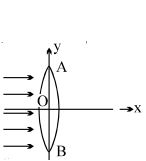
Monochromatic light rays parallel to $x$ -axis strike a convex lens $AB$. If the lens oscillates such that $AB$ tilts upto a small angle $\theta$ (in radian) on either side of $y$ -axis, then the amplitude of oscillation of image will be ($f =$ focal length of the lens):
  • A
    $f\, sec \, \theta$
  • B
    $f\, sec^2\, \theta$
  • C
    $\frac{{{\text{f }}{\theta ^2}}}{2}$
  • $\frac{{{\text{f }}{\theta ^2}}}{4}$
Answer

Correct option: D.
$\frac{{{\text{f }}{\theta ^2}}}{4}$
d

Need a full question paper?

Generate a complete, print-ready paper with questions like this in minutes — across 16+ boards, with answer keys.

Start Generating Free

Similar questions

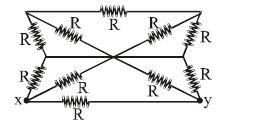
What will be equivalent resistance of circuit between $x$ and $y$ 
Which of the following rays has the maximum frequency
If two charged particles of same mass and charge are projected in a uniform electric field with the same speed, then?
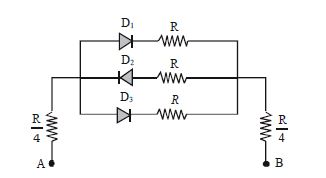
In the following circuits $PN-$ junction diodes $D_1, D_2$ and $D_3$ are ideal for the following potential of $A$ and $B,$ the correct increasing order of resistance between $A$ and $B$ will be

$(i) -10\ V, -5\ V$ 

$(ii) -5\ V, -10\ V$

$(iii)-4\ V, -12\ V$

Which one of the following alternative is $FALSE$ for a prism placed in a position of minimum deviation
For a telescope in normal adjustment, the length of telescope is found to be $27\,cm$. If the magnifying power of telescope, at normal adjustment is 8 , the focal lengths of objective and eye piece are respectively
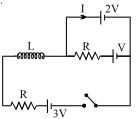
In the $LR$ circuit shown, what is the variation of the current $I$ as $a$ function of time? The switch is closed at time $t = 0 \,sec.$
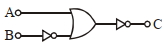
The logic circuit shown above is equivalent to :
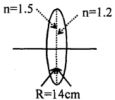
A bi-convex lens is formed with two thin plano-convex lenses as shown in the figure. Refractive index of the first lens is $1.5$ and that of the second lens is $1.2$. Both the curved surfaces are of the same radius of curvature $R = 14\; cm$. For this bi-convex lens, for an object distance of $40\; cm$, the image distance will be
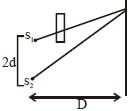
If a thin mica sheet of thickness $'t'$ and refractive index $\mu = 5/3$ is placed in the path of one of the interfering beams as shown in fig. then the displacement of the fringe system is