MCQ
Monochromatic radiation emitted when electron on hydrogen atom jumps from first excited to the ground state irradiates a photosensitive material. The stopping potential is measured to be $3.57 \;V$. The threshold frequency of the material is .........$ \times 10^{15}\; Hz$
  • A
    $2.5$
  • $1.6$
  • C
    $4$
  • D
    $5$

Answer

Correct option: B.
$1.6$
b
Energy released from emmition of electron is $E =(-3.4)-(-13.6)=10.2 eV$.

From photo-electric equation, work function $\phi= E - eV = h v _0$

On Solving this $v _0=1.6 \times 10^{15} Hz$

Need a full question paper?

Generate a complete, print-ready paper with questions like this in minutes — across 16+ boards, with answer keys.

Start Generating Free

Similar questions

The force on a charge situated on the axis of a dipole is $F$. If the charge is shifted to double the distance, the new force will be
A charged particle of mass $5 \times 10^{-5} \mathrm{~kg}$ is held stationary in space by placing it in an electric field of strength $10^7 \mathrm{NC}^{-1}$ directed vertically downwards. The charge on the particle is
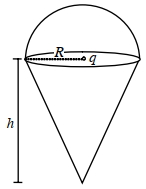
A charge $q$ is surrounded by a closed surface consisting of an inverted cone of height $h$ and base radius $R$, and a hemisphere of radius $R$ as shown in the figure. The electric flux through the conical surface is $\frac{n q}{6 \in_0}$ (in SI units). The value of $n$ is. . . . 
According to Ohm's law, relation between current density $j$ and intensity of electric field $E$ is :
A  piano convex lens fits exactly into a piano concave lens. Their plane surfaces are parallel to each other. If lenses are made of different materials of refractive indices $\mu _1$ and $\mu _2 $ and $R$ is the radius of curvature of the curved surface of the lenses, then the focal length of the combination is 
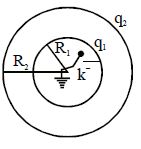
Two concentric spherical shells of radius $R_1$ and $R_2$ have $q_1$ and $q_2$ charge respectively as shown in figure. How much charge will flow through key $k$ when it is closed
The energy of a charged capacitor is given by the expression (q = charge on the conductor and C = its capacity)
A convex lens $A$ of focal length $20 cm$ and a concave lens $B$ of focal length $5 cm$ are kept along the same axis with the distance $d$ between them. If a parallel beam of light falling on $A$ leaves $B$ as a parallel beam, then distance $d$ in $cm$ will be
Assertion : Photosensitivity of a metal is high if its work function is small.
Reason : Work function $= hf_0$ where $f_0$ is the threshold frequency.
The internal resistance of a cell depends on