Question
Moseley's Law for characteristic X-ray is $\sqrt{\text{v}}=\text{a}(\text{z}-\text{b})$. Here,

Answer

  1. Both a and b are independent of the material.
Explanation:
Moseley's Law for characteristic X-ray is $\sqrt{\text{v}}=\text{a}(\text{z}-\text{b})$where, a and b are constants independent of the material used.

Need a full question paper?

Generate a complete, print-ready paper with questions like this in minutes — across 16+ boards, with answer keys.
Start Generating Free

Similar questions

Two parallel circular coils of equal radii having equal number of turns placed coaxially and separated by a distance equal to the radii of the coils carrying equal currents in same direction are known as:
 ————— gives the information on field strength, direction, and nature of the charge.
The inductance of a closed$-$packed coil of $400$ turns is $8 \ mH .$ A current of $5 \ mA$ is passed through it. The magnetic flux through each turn of the coil is
Wheatstones’s bridge cannot be used for measurement of very _______ resistances.
Assertion :   The specific charge for positive rays is a characteristic constant.
Reason     : The specific charge depends on charge and mass of positive ions present in positive rays.(a) If both assertion and reason are true and the reason is the correct explanation of the assertion.(b) If both assertion and reason are true but reason is not the correct explanation of the assertion.(c) If assertion is true but reason is false.(d) If the assertion and reason both are false.


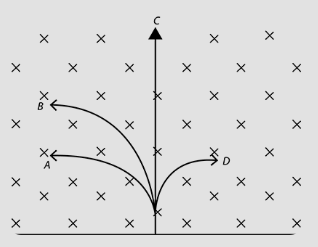
A neutron, a proton, an electron and an α−particle enter a region of uniform magnetic field with equal velocities. The magnetic field is perpendicular to the plane of paper and directed into it. The tracks of particles are labeled in the figure. The neutron follows the track:
A element used for radioactive carbon dating for more than 5600 years is(a) C - 14 (b) U - 234(c) U - 238(d) Po - 94
       
An elementary particle of mass $m$ and charge $+e$ is projected with velocity $v$ at a much more massive particle of charge $Ze,$ where $Z > 0$. What is the closest possible approach of the incident particle
Identify the type of conductor in which the variation of current with potential difference may depend upon the sign of the potential difference applied.
While doing his experiment, Millikan one day observed the following charges on a single drop
$(i)\  6.563 \times 10^{-19} \mathrm{C}$
$(ii)\ 8.204 \times 10^{-19} \mathrm{C}$
$(iii)\ 11.50 \times 10^{-19} \mathrm{C}$
$(iv)\ 13.13 \times 10^{-19} \mathrm{C}$
$(v)\ 16.48 \times 10^{-19} \mathrm{C}$
$(vi)\ 18.09\times 10^{-19} \mathrm{C}$
From this data the value of the elementary charge $(e)$ was found to be