MCQ
Most common oxidation states of $Ce$ are
- A$+ 2, + 3$
- B$+ 2, + 4$
- ✓$+ 3, + 4$
- D$ + 3, + 5$
Generate a complete, print-ready paper with questions like this in minutes — across 16+ boards, with answer keys.
Reason : $Six F$ atoms in $SF_6$ prevent the attack of $H_2O$ on sulphur atom of $SF_6$.
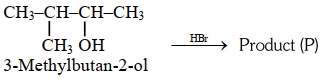
$\mathop {\begin{array}{*{20}{c}}
{\,\,\,\,\,\,\,\,\,\,\,\,\,\,O}\\
{\,\,\,\,\,\,\,\,\,\,\,\,\,\,||}\\
{CH \equiv C - C - OH}
\end{array}}\limits_{\rm{I}} $ $\mathop {\begin{array}{*{20}{c}}
{\,\,\,\,\,\,\,\,\,\,\,\,\,\,\,\,\,\,\,O}\\
{\,\,\,\,\,\,\,\,\,\,\,\,\,\,\,\,\,\,\,||}\\
{C{H_2} = CH - C - OH}
\end{array}}\limits_{{\rm{II}}} $ $\mathop {\begin{array}{*{20}{c}}
{\,\,\,\,\,\,\,\,\,\,\,\,\,\,\,\,\,\,\,O}\\
{\,\,\,\,\,\,\,\,\,\,\,\,\,\,\,\,\,\,\,||}\\
{C{H_3} - C{H_2} - C - OH}
\end{array}}\limits_{{\rm{III}}} $$\mathop {\begin{array}{*{20}{c}}
\,\,\,{C{H_3}\,\,\,\,\,\,O}\\
\,\,\,{|\,\,\,\,\,\,\,\,\,\,\,\,\,\,\,||}\\
{C{H_3} - CH - C - OH}
\end{array}}\limits_{{\rm{IV}}} $
$\left. \begin{gathered}
(A)\,\,\xrightarrow{{PB{r_3}}}\,(C)\,\xrightarrow{{Mg\,,\,ether}}Grignard\,\,reagent \hfill \\
(A)\,\,\xrightarrow[{{H_2}S{O_4}}]{{N{a_2}C{r_2}{O_7}}}\,(B) \hfill \\
\end{gathered} \right\}$ $ \to \,(D)\xrightarrow{{{H_3}{O^ \oplus }}}$ $(3,4-$ dimethyl $3-$ hexanol$)$