$n$ identical cells are joined in series with two cells $A$ and $B$ with reversed polarities. $emf$ of each cell is $E$ and internal resistance is $r$. Potential difference across cell $A$ and $B$ is : $(n > 4)$
Medium
Download our app for free and get started
Net $\mathrm{emf}$ of the circuit $= (n -2) E -2E = (n -4)E$ total resistance of the circuit $= nr$
$\therefore $ Current in the circuit will be,
$\mathrm{i}=\frac{(\mathrm{n}-4) \mathrm{E}}{\mathrm{nr}}$
Hence, potential difference across $\mathrm{A}$ or $\mathrm{B}$ is,
${\mathrm{V}=\mathrm{E}+\mathrm{Ir}=\mathrm{E}+\frac{(\mathrm{n}-4) \mathrm{E}}{\mathrm{nr}} \cdot \mathrm{r}} $
${=2 \mathrm{E}\left(1-\frac{2}{\mathrm{n}}\right)}$

Download our appand get started for free
Experience the future of education. Simply download our apps or reach out to us for more information. Let's shape the future of learning together!No signup needed.*
Similar Questions
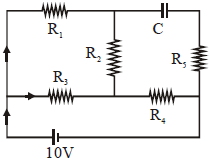
- 1An ideal cell of emf $10\, V$ is connected in circuit shown in figure. Each resistance is $2\, \Omega .$ The potential difference (in $V$) across the capacitor when it is fully charged isView Solution
- 2Two cells of $emfs$ $E_1$ and $E_2$ and internal resistances $r_1$ and $r_2$ are connected in parallel. The $emf$ and internal resistance of the equivalent source isView Solution
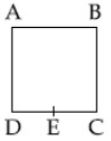
- 3A wire of resistance $R$ is bent to form a square $ABCD$ as shown in the figure. The effective resistance between $E$ and $C$ is ( $E$ is mid-point of arm $CD$ )View Solution
- 4View SolutionAssertion : Ohm's law is applicable for all conducting elements.
Reason : Ohm's law is a fundamental law
- 5A uniform wire of length $l$ and radius $r$ has a resistance of $100\, \Omega $. It is recast into a wire of radius $\frac{r}{2}$. The resistance of new wire will be ............... $\Omega$View Solution
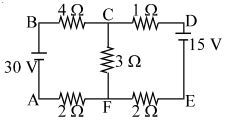
- 6The figure shows a network of five resistances and two batteries The current through the $30\,V$ battery is ............... $A$View Solution
- 7Three resistors are connected to form the sides of a triangle $ABC$, the resistance of the sides $AB$, $BC$ and $CA$ are $40\,ohms$, $60\,ohms$ and $100\,ohms$ respectively. The effective resistance between the points $A$ and $B$ in $ohms$ will beView Solution
- 8View SolutionAcross a metallic conductor of non-uniform cross section a constant potential difference is applied. The quantity which remains constant along the conductor is
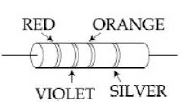
- 9View SolutionA resistance is shown in the figure. Its value and tolerance are given respectively by
- 10In a neon discharge tube $2.9 \times {10^{18}}\,N{e^ + }$ ions move to the right each second while $1.2 \times {10^{18}}$ electrons move to the left per second. Electron charge is $1.6 \times {10^{ - 19}}\,C$. The current in the discharge tubeView Solution