Question
Name the raw materials required for photosynthesis. How do plants obtain these raw materials?

Answer

The raw materials for photosynthesis are carbon-dioxide and water. The green plants take carbon-dioxide from air for photosynthesis. The carbon-dioxide gas enters the leaves of the plants through the stomata present on their surface. The water required by the plants for photosynthesis is absorbed by the roots of the plants from the soil through the process of osmosis. The water absorbed by the roots is transported upwards through the xylem vessels to the leaves where it reaches the photosynthetic cells and utilized in photosynthesis.

Need a full question paper?

Generate a complete, print-ready paper with questions like this in minutes — across 16+ boards, with answer keys.
Start Generating Free

Similar questions

Give the various functions of brain.
The pancreas is made up of two parts A and B. The part A secretes insulin whereas part B secretes pancreatic juice.
  1. Which part is functioning as an endocrine gland? Why?
  2. What is insulin and what effect does it have in the body?
  3. Name the disease which can be treated by giving insulin injection.
  4. What does pancreatic juice contain? Where does pancreatic juice go?
  5. Name the life process in which pancreatic juice is made use of.
Describe the process of nutrition in Draw labelled diagrams to show the various steps in the nutrition in Amoeba.
Sketch, labell and classify: Shark
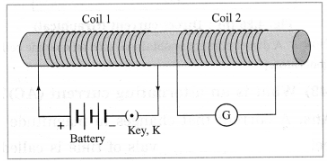
Take two coils of about 50 turns. Insert them over a nonconducting cylindrical roll as shown in Figure.
Image

(A thick paper roll can be used.) Connect coil 1 to a battery with a plug key K. Connect coil 2 to a galvanometer G. (1) Plug the key and observe the deflection in the galvanometer. (2) Unplug the key and again observe the deflection.
Note your observations. What conclusions do you draw from these observations?
A person buys two electrical devices P and Q for lighting purposes in his house. The device P consumes only 5 units of electricity in a month but device Q consumes 15 units of electricity in a month when used for the same number of hours daily. The device Q wastes a lot of electricity by radiating energy C but P does not do so.
  1. What type of device is (i) P, and (ii) Q?
  2. Name one component which is present in Q but not in P.
  3. Name the energy C.
  4. Which device is more energy efficient: P or Q?
  5. Which fossil fuel is most likely to be conserved if all of us switch over to devices like P?
Why does human being have an important place in the environment?
If a person weighs $750 N$ on Earth, what will be the weight of the person on moon?
(The mass of moon is $\frac{1}{81}$ times the mass earth and its radius is $\frac{1}{3.7}$ times that of earth.)
A person first crossed pure-bred pea plants having round-yellow seeds with pure-bred pea plants having wrinkled-green seeds and found that only $A-B$ type of seeds were produced in the $F_1$ generation. When $F_1$ generation pea plants having $A-B$ type of seeds were cross-bred by self-pollination, then in addition to the original round-yellow and wrinkled-green seeds, two new varieties $A-D$ and $C-B$ type of seeds were also obtained.
  1. What are $A-B$ type of seeds$?$
  2. State whether $A$ and $B$ are dominant traits or recessive traits.
  3. What are $A-D$ type of seeds$?$
  4. What are $C-B$ type of seeds$?$
  5. Out of $A-B$ and $A-D$ types of seeds, which one will be produced in $(i)$ minimum numbers, and $(ii)$ maximum numbers, in the $F_2$ generation?
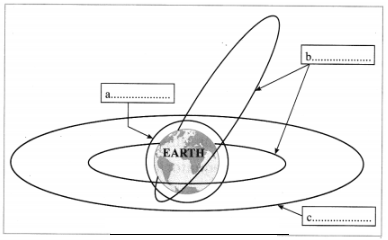
Write the proper name of the orbits of satellites shown in the following figure with their height from the earth’s surface. (Practice Activity Sheet – 4)

Image