MCQ
Name the unit of electrical potential:
- ACoulomb
- BWatt
- CJoule
- DVolt
Explanation:
Electrical potential is a type of potential energy, and refers to the energy that could be released if electric current is allowed to flow.
Generate a complete, print-ready paper with questions like this in minutes — across 16+ boards, with answer keys.
A proton and an a-particle are accelerated through a potential difference of 100 V. The ratio of the wavelength associated with the proton to that associated with an a-particle is
|
(a) |
(b) 2 : 1 |
(c) 2 |
(d) |
A sample of radioactive element has a mass of 10 gm at an instant t = 0.The approximate mass of this element in the sample after two mean lives is
|
(a) 2.50 gm |
(b) 3.70 gm |
(c) 6.30 gm |
(d) 1.35 gm |
The phenomenon of interference is shown by
|
(a) Longitudinal mechanical waves only |
(b) Transverse mechanical waves only |
|
(c) Electromagnetic waves only |
(d) All the above types of waves |
The points resembling equal potentials are
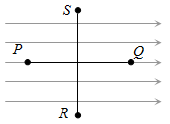
|
(a) P and Q |
(b) S and Q |
(c) S and R |
(d) P and R |
Shown in the figure is a circular loop of radius r and resistance R. A variable magnetic field of induction  is established inside the coil. If the key (K) is closed, the electrical power developed right after closing the switch is equal to
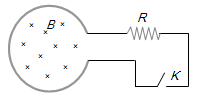
|
(a) |
(b) |
(c) |
(d) |
Figure represents a glass plate placed vertically on a horizontal table with a beam of unpolarised light falling on its surface at the polarising angle of 57o with the normal. The electric vector in the reflected light on screen S will vibrate with respect to the plane of incidence in a
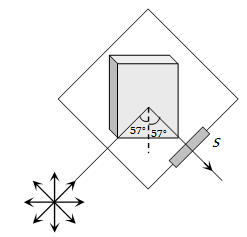
|
(a) Vertical plane |
|
(b) Horizontal plane |
|
(c) Plane making an angle of 45o with the vertical |
|
(d) Plane making an angle of 57o with the horizontal |


