Question
Nematode specific genes were introduced into the tobacco host plant using a vector:
  1. pBR 322.
  2. Plasmid.
  3. Bacteriophage.
  4. Agrobacterium.

Answer

  1. Agrobacterium.

Need a full question paper?

Generate a complete, print-ready paper with questions like this in minutes — across 16+ boards, with answer keys.
Start Generating Free

Similar questions

Explain co-dominance in humans with the help of example.
Explain Species-Area relationships graph.
Read the following and answer any four questions from (i) to (v) given below:
Enzymes are best known for their ability to catalise biochemical reactions without undergoing any change. A large number of enzymes are being used in biotechnological industry. Most of them are obtained from microbes. Proteases degrade proteins and polypeptides. Most of the commercially applicable proteases are alkaline and are biosynthesised mainly by bacteria such as Pseudomonas, Bacillus and some fungi like, Aspergillus. These enzymes are used in clearing beer, softening of bread and meat, degumming of silk, etc. Alkaline serine proteases have the largest applications in bio-industry. Alkaline proteases have shown their capability to work under high pH, temperature and in presence of inhibitory compounds. Another important group of enzymes is amylases. Amylolytic enzymes act on starch. These are obtained from Aspergillus, Rhizopus and Bacillus sp. These are used in softening and sweetening of bread, production of alcoholic beverages from starchy materials, clearing of turbidity in juices caused by starch, etc.
  1. Polypeptides are degraded by:
  1. Amylases.
  2. Proteases.
  3. Pectinases.
  4. Lipases.
  1. Amylolytic enzymes are not obtained from:
  1. Aspergillus.
  2. Aspergillus.
  3. Mucor.
  4. Bacillus.
  1. Clearing of turbidity in juices caused by starch is achieved by:
  1. Amylases.
  2. Proteases.
  3. Rennet.
  4. Both (a) and (b).
  1. Select the incorrect option from the following.
  1. Enzymes are proteinaceous substances.
  2. Enzymes are substrate specific.
  3. Enzymes are large sized molecules.
  4. Microbial enzymes can work only in normal temperature and pH.
  1. A farmer harvests corns and prepares corn starch. He wants to prepare some corn syrup from this. for the conversion he needs to use enzyme ______.
  1. Amylase.
  2. Glucoamylases.
  3. Glucoisomerases.
  4. All of these.
Read the following text carefully and answer the questions that follow:
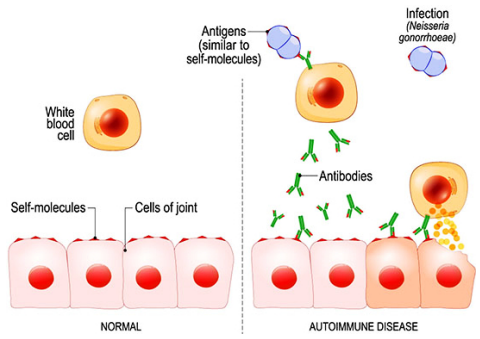
A healthy immune system defends the body against disease and infection. But if the immune system malfunctions, it mistakenly attacks healthy cells, tissues, and organs. Called autoimmune disease, these attacks can affect any part of the body, weakening bodily function and even turning life-threatening.
Image
i. Why are autoimmune diseases called degenerative diseases? (1)
ii. Name the autoimmune disease of body muscles. (1)
iii. Which types of immunity is provided by T-lymphocytes? (2)
OR
Which immune cells form humoral immune system? (2)
Read the following and answer any four questions from (i) to (v) given below:
Disposal of untreated sewage into the river or freshwater pond causes huge water pollution. Four water samples from different sources (A, B, C, D) are collected and tested for BOD value in a lab to assess their quality. The BOD values are presented in the given table. Water samples are collected from primary effluent, secondary effluent, untreated sewage and river water. Study the given table and answer the following.
Sample BOD
A 20mg/ L
B 5mg/ L
C 300mg/ L
D 400mg/ L
  1. The source of sample 'C' is:
  1. River water.
  2. Primary effluent.
  3. Secondary effluent.
  4. Untreated sewage water.
  1. If sewage in untreated condition is disposed off in a freshwater body then.
  1. BOD and dissolved oxygen both will increase.
  2. BOD will increase and dissolved oxygen will decreas.
  3. BOD will decrease and dissolved oxygen will increase.
  4. BOD and dissolved oxygen both will decrease.
  1. A large number of pathogenic microbes can be present in water sample of:
  1. C
  2. A
  3. D
  4. Both (a) and (c).
  1. High value of BOD in sample O is due to:
  1. High amount of organic wastes and aerobic microbes.
  2. High amount of inorganic wastes and anaerobic microbes.
  3. High amount of organic wastes and anaerobic microbes.
  4. High amount of inorganic wastes and aerobic microbes.
  1. River water is represented by the sample.
  1. A
  2. B
  3. C
  4. D
Suggest some methods to assist infertile couples to have children.
Early diagnosis is not possible by traditional methods for diagnosis and treatment- discuss in detail.
Read the following text carefully and answer the questions that follow:
Malaria and dengue fever are major mosquito-borne public health problems in tropical countries. The authors report a malaria and dengue co-infection in an 11-year-old boy who presented with sustained fever for 10 days. The physical examination revealed a flushed face, injected conjunctivae and left submandibular lymphadenopathy. His peripheral blood smear showed few ring-form trophozoites of Plasmodium falciparum. His blood tests were positive for dengue NS-1 antigen and IgM antibody, and negative for IgG antibody. After the initiation of antimalarial treatment with artesunate and mefloquine, his clinical condition gradually improved. However, he still had low-grade fever that persisted for 6 days. Finally, he recovered well without fluid leakage, shock or severe bleeding.
i. Name the fish that help in eradication of mosquito larvae.
ii. What is the reason of symptoms of malaria?
iii. Name the body parts and host in which following events takes place in life cycle of plasmodium.
a. asexual reproduction
b. sexual reproduction.
OR
Name some vector borne diseases and their vector.
Read the following and answer any four questions from (i) to (v) given below:

Riya studies in 11 standard in a government school. She belongs to a backward family and her parents did not get her properly vaccinated according to immunisation programme. Once while playing in school playground she fell down due to weakness and developed high fever, headache and stiffness in her neck. identify the illness she could be suffering from and answer the following questions.

  1. The microbe responsible for Riya's illness could be.
  1. Vibrio cholerae
  2. Enterovirus
  3. Plasmodium
  4. Mycobacteriurn.
  1. Which vaccine, if administered earlier, would have saved Riya from the illness she unfortunately contracted?
  1. Salk vaccine
  2. MMR vaccine
  3. BCG vaccine
  4. Varicella vaccine
  1. The disease that Riya has contracted spreads through.
  1. Bite of an infected mosquito
  2. Bite of an infected dog
  3. Faecal oral route
  4. Direct contact with the infected person.
  1. Riya can spread her illness to other children through.
  1. Her faeces
  2. Direct contact
  3. Coughing and sneezing in open
  4. Vectors.
  1. Assertion: Polio produces inflammation of the nervous system.

Reason : Stiffness of the neck, paralysis of particular skeletal muscle, is an important symptom of polio.

  1. Both assertion and reason are true, and reason is the correct explanation of assertion.
  2. Both assertion and reason are true, but reason is not the correct explanation of assertion.
  3. Assertion is true, but reason is false.
  4. Both assertion and reason are false.
Read the following and answer any four questions from (i) to (v) given below:

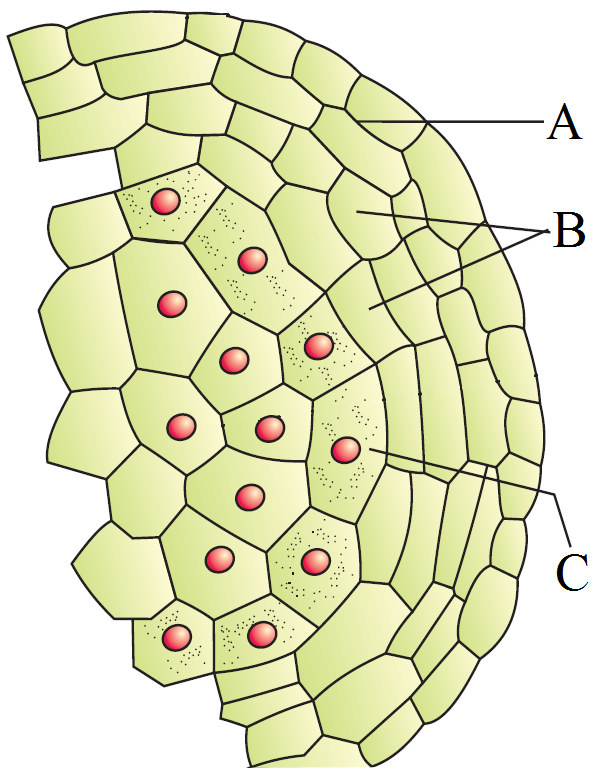
The anther is a four-sided structure consisting of four microsporangia located at the corners, two in each lobe. TI1e microsporangia develop further and become pollen sacs. In a transverse section, a typical microsporangium appears near circular in outline. It is generally surrounded by four wall layers-the epidermis, endothecium, middle layers and the tapetum.

  1. A dithecous another consists of (A) microsporangia, (B) in each lobe.

Select the option that correctly fills the blanks.

S. No
A
B
(a)
Four
Two
(b)
Two
One
(c)
Two
Two
(d)
Four
One
  1. The given diagram shows microsporangium of a mature anther. Identify A, B and C.

(a)
A-Middle layer
B-Endothecium
C-Tapetum
(b)
A-Endothecium
B-Tapetum
C- Middle layer
(c)
A-Endothecium
B-Middle layer
C-Tapetum
(d)
A-Tapetum
B-Middle layer
C-Endothecium
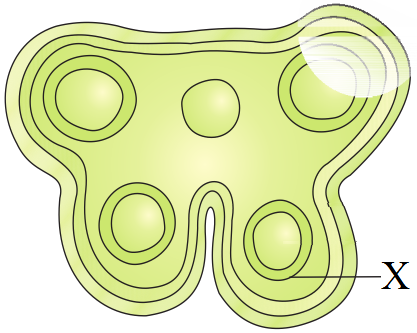
  1. The function of labelled part X is:

  1. Dehiscence.
  2. Mechanical.
  3. Nutrition.
  4. Protection.
  1. Select the incorrect statement.
  1. Microsporangium is generally surrounded by four wall layers-epidermis, endothecium, middle layers and tapetum.
  2. Outer three layers perform functions of protection and dehiscence of anthers.
  3. Cells of tapetum possess dense cytoplasm and generally have more than one nucleus.
  4. Cells of tapetum undergo meiosis and produce microspore tetrads.
  1. Which function oftapetum is correct?
  1. Helps in pollen wall formation.
  2. Transportation of nutrients to inner side of another.
  3. Synthesis of callase enzyme for separation of microspore tetrads.
  4. All of these.