MCQ
Nitrogen differs from $\text{P, As, Sb}$ and $Bi$ in the following properties:
  • A
    It forms diatomic molecule.
  • B
    It is not able to extent its coordination number beyond four.
  • C
    Nitrogen does not function as a Lewis acid whereas $\text{P, As, Sb}$ and $Bi$ do so.
  • In all the properties given above.

Answer

Correct option: D.
In all the properties given above.
As vacant $d-$orbital are present in $P$ and other elements of this group except $N$ so they can expand their valency and forms stable pentavalence product but due to absence of $d-$orbitals nitrogen cannot form pentavalence products. It forms diatomic molecule $N_2$
Nitrogen does not function as a Lewis acid due to absence of $d-$orbitals and it is a Lewis base due to presence of lone pair.

Need a full question paper?

Generate a complete, print-ready paper with questions like this in minutes — across 16+ boards, with answer keys.

Start Generating Free

Similar questions

$\begin{array}{*{20}{c}}
  {O\,\,\,\,\,\,\,\,\,\,\,\,\,\,} \\ 
  {||\,\,\,\,\,\,\,\,\,\,\,\,\,\,\,} \\ 
  {C{H_3} - C - O - {C_2}{H_5}} 
\end{array}$ $\xrightarrow{{{H_2}N - N{H_2}}}X$;  $\begin{array}{*{20}{c}}
  {\,\,\,\,\,\,\,O\,\,\,\,\,\,\,\,\,\,} \\ 
  {\,\,\,\,\,\,\,\,||\,\,\,\,\,\,\,\,\,\,\,} \\ 
  {C{H_3} - C - {C_2}{H_5}} 
\end{array}$ $\xrightarrow{{{H_2}N - N{H_2}}}Y$

$X$ and $Y$ are

On heating with concentrated $\text{NaOH}$ solution in an inert atmosphere of $\ce{CO_2}$, white phosphorus gives a gas. Which of the following statement is incorrect about the gas?
Molar conductances of $BaCl_2, H_2SO_4$ and $HCl$ at infinite dilutions are $x_1, x_2$  and $x_3$, respectively. Equivalent conductance of $BaSO_4$ at infinite dilution  will be
When $FeCl_3$ reacts with $K_4[Fe(CN)_6]$ then which of the following compound is formed
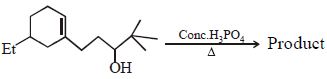
The major product of the reaction is :
Major product of the following reaction is
For a reaction taking place in three steps at same temperature, overall rate constant $\mathrm{K}=\frac{\mathrm{K}_1 \mathrm{~K}_2}{\mathrm{~K}_3}$. If $\mathrm{Ea}_1, \mathrm{Ea}_2$ and $\mathrm{Ea}_3$ are $40$,$50$ and $60 \mathrm{~kJ} / \mathrm{mol}$ respectively, the overall $\mathrm{Ea}$ is ________ $\mathrm{kJ} / \mathrm{mol}$.
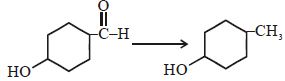
Which of the following can be used in above reaction as a reagent ?
Consider the following reaction

$\begin{array}{*{20}{c}}
{\,\,\,\,\,C{H_3}\,\,\,\,\,\,\,\,\,}\\
{|\,\,\,\,\,\,\,\,\,\,}\\
{C{H_3} - C - O - C{H_3}}\\
{|\,\,\,\,\,\,\,\,\,\,\,}\\
{\,\,\,\,\,\,\,{\kern 1pt} C{H_3}\,\,\,\,\,\,\,\,\,\,\,\,\,}
\end{array}\,\,$ $\xrightarrow[{(1\,Mole)}]{{HI}}$ Products

The main products of reaction will be

In the given Cannizzzaro's reaction the slowest step is

$2Ph - CHO\xrightarrow{{KOH}}Ph - C{H_2}OH + PhCO_2^ - $