Question
No interference pattern is detected when two coherent sources are infinitely close to each other. Why?

Answer

Fringe width of interference fringes is given by $\beta=\frac{\text{D}\lambda}{\text{d}}\alpha\frac{1}{\text{d}}.$ When d is infinitely small, fringe width β will be too large. In such a case even a single fringe may occupy the whole field of view. Hence, the interference pattern cannot be detected.

Need a full question paper?

Generate a complete, print-ready paper with questions like this in minutes — across 16+ boards, with answer keys.
Start Generating Free

Similar questions

A barometer is constructed with its tube having radius $1.0\ mm$. Assume that the surface of mercury in the tube is spherical in shape. If the atmospheric pressure is equal to $76\ cm$ of mercury, what will be the height raised in the barometer tube. The contact angle of mercury with glass $= 135^\circ$ and surface tension of mercury $= 0.465N/m$. Density of mercury $= 13600\ kg/m^3$.
Work function of sodium is 2.3eV. Does sodium show photoelectric emission for light of wavelength $6800\mathring{\text{A}}?$
What do you mean by drift velocity and mobility ?
Show diagrammatically the behaviour of magnetic field lines in the presence of (i) paramagnetic and (ii) diamagnetic substances. How does one explain this distinguishing feature?
Write statement of Lenz's law of electromagnetism. A 2 m long straight vertical wire is falling perpendicularly to horizontal component at speed of 5 $m / s$ in the magnetic field of earth of $0.3 \times 10^{-4} T$. Calculate the magnitude of instantaneous value of induced emf across the ends of the wire.
What is image? Explain its types.
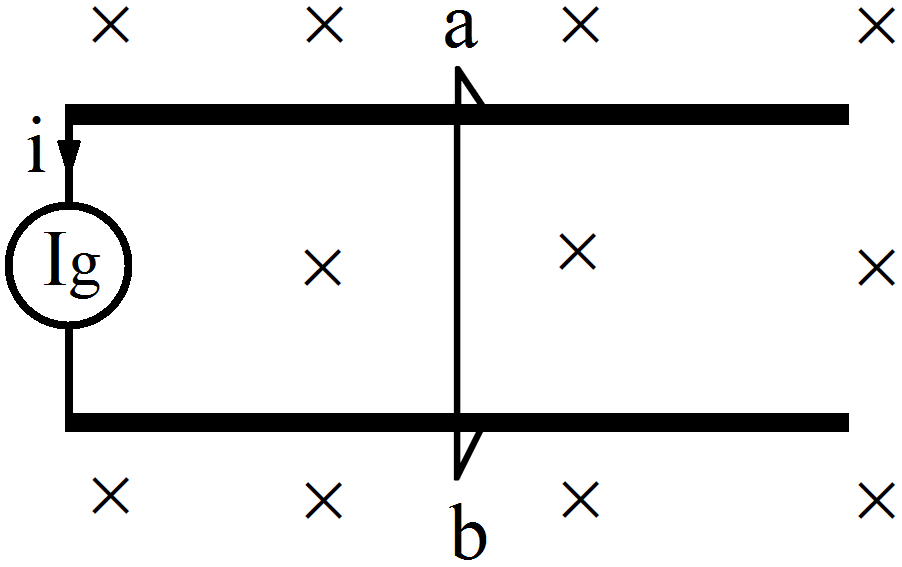
The current generator $I_g$ shown in figure, sends a constant current i through the circuit. The wire ab has a length l and mass m and can slide on the smooth, horizontal rails connected to $I_g$. The entire system lies in a vertical magnetic field $B$. Find the velocity of the wire as a function of time.
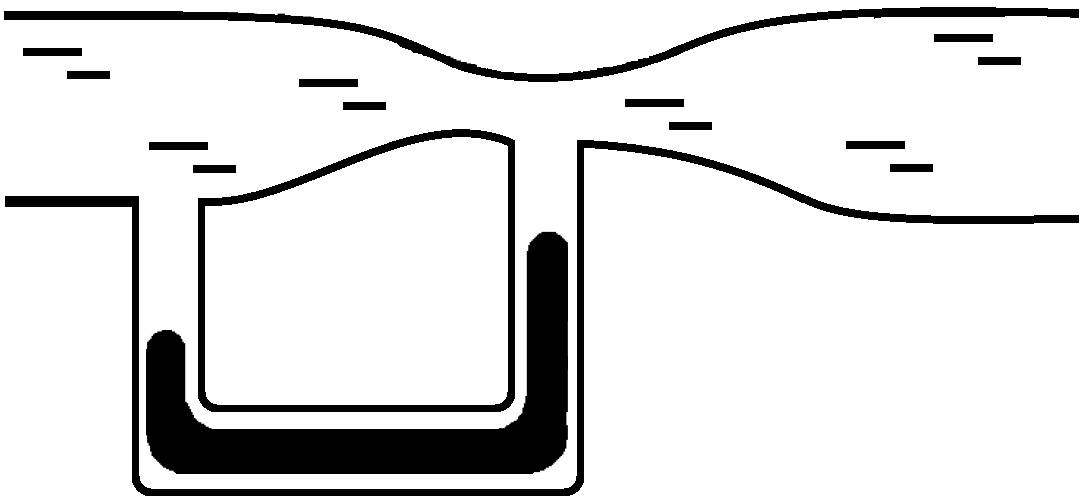
Water flows through the tube shown in The areas of cross$-$section of the wide and the narrow portions of the tube are $5\ cm^2$ and $2\ cm^2$ respectively. The rate of flow of water through the tube is $500\ cm^3/s.$ Find the difference of mercury levels in the $U-$tube.
Draw a plot showing the variation of (i) electric field (E) and (ii) electric potential (V) with distance r due to a point charge Q.
If the resultant torque of all the forces acting on a body is zero about a point, is it necessary that it will be zero about any other point?