Question
No work is done by a force on an object if:
  1. The force is always perpendicular to its velocity.
  2. The force is always perpendicular to its acceleration.
  3. The object is stationary but the point of application of the force moves on the object.
  4. The object moves in such a way that the point of application of the force remains fixed.
Answer

  1. The force is always perpendicular to its velocity.
  1. The object is stationary but the point of application of the force moves on the object.
  2. The object moves in such a way that the point of application of the force remains fixed.
Explanation:

No work is done by a force on an object if the force is always perpendicular to its velocity. Acceleration does not always provide the direction of motion, so we cannot say that no work is done by a force on an object if it is always perpendicular to the acceleration. Work done is zero when the displacement is zero.

In a circular motion, force provides the centripetal acceleration. The angle between this force and the displacement is 90°, so work done by the force on an object is zero.

Need a full question paper?

Generate a complete, print-ready paper with questions like this in minutes — across 16+ boards, with answer keys.

Start Generating Free

Similar questions

A force of 200N is required to push a car of mass 500kg slowly at constant speed on a level road. If a force of 500N is applied, the acceleration of the car (in ms-2) will be:
The specific heat of a gas:
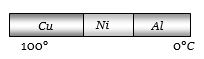
A composite metal bar of uniform section is made up of length $25 cm$ of copper, $10  cm$ of nickel and $15 cm$ of aluminium. Each part being in perfect thermal contact with the adjoining part. The copper end of the composite rod is maintained at ${100^o}C$ and the aluminium end at ${0^o}C$. The whole rod is covered with belt so that there is no heat loss occurs at the sides. If ${K_{{\rm{Cu}}}} = 2{K_{Al}}$ and ${K_{Al}} = 3{K_{{\rm{Ni}}}}$, then what will be the temperatures of $Cu - Ni$ and $Ni - Al$ junctions respectively
A car travels half the distance with constant velocity of $40\, kmph$ and the remaining half with a constant velocity of $60 \,kmph$. The average velocity of the car in $kmph$ is
 A $10 \;N$ force is applied on a body produce in it an acceleration of $1 \;m / s ^{2} .$ The mass of the body is ...... $kg$
A simple harmonic progressive wave is represented by the equation : $y = 8\sin 2\pi (0.1x - 2t)$ where $x$ and $y$ are in $cm$ and $t$ is in seconds. At any instant the phase difference between two particles separated by $2.0 \,cm$ in the $x-$direction is ..... $^o$
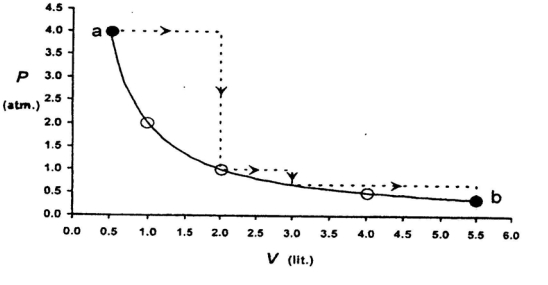
One mole of an ideal gas is taken from a to $b$ along two paths denoted by the solid and the dashed lines as shown in the graph below. If the work done along the solid line path is $\mathrm{w}_{\mathrm{s}}$ and that along the dotted line path is $w_d$, then the integer closest to the ratio $w_d / w_5$ is
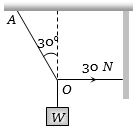
As shown in figure the tension in the horizontal cord is $30 \,N$. The weight $W$ and tension in the string $OA$  in Newton are
Each of the properties of sound listed in column $A$ primarily depends on one of the quantities in column $B$. Choose the matching pairs from two columns

Column $A$          Column $B$

Pitch                   Waveform

Quality                Frequency

Loudness            Intensity

Consider $1 \,kg$ of liquid water undergoing change in phase to water vapour at $100^{\circ} C$. At $100^{\circ} C$, the vapour pressure is $1.01 \times 10^5 \,N - m ^2$ and the latent heat of vaporization is $22.6 \times 10^5 \,Jkg ^{-1}$. The density of liquid water is $10^3 \,kg m ^{-3}$ and that of vapour is $\frac{1}{1.8} \,kg m ^{-3}$. The change in internal energy in this phase change is nearly ............ $\,J kg ^{-1}$