MCQ
The specific heat of a gas:
  • A
    Has only one value.
  • B
    Is proportional to the square root of its absolute temperature.
  • C
    Has two values CP and CV.
  • D
    Can have any value between o and infinity.

Answer

  1. Can have any value between o and infinity.

Explanation:

The specific heat of a gas at constant pressure is the amount of heat required to raise the temperature of one mole of a gas by unit temperature at constant pressure.

Need a full question paper?

Generate a complete, print-ready paper with questions like this in minutes — across 16+ boards, with answer keys.
Start Generating Free

Similar questions

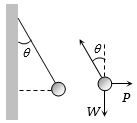
A metal sphere is hung by a string fixed to a wall. The sphere is pushed away from the wall by a stick. The forces acting on the sphere are shown in the second diagram. Which of the following statements is wrong
If the temperature of a black body be increased from ${27^o}C$ to ${327^o}C$ the radiation emitted increases by a fraction of
The temperature of equal masses of three different liquids ${x}, {y}$ and ${z}$ are $10^{\circ} {C}, 20^{\circ} {C}$ and $30^{\circ} {C}$ respectively. The temperature of mixture when ${x}$ is mixed with ${y}$ is $16^{\circ} {C}$ and that when ${y}$ is mixed with $z$ is $26^{\circ} {C}$. The temperature of mixture when $x$ and $z$ are mixed will be ...... $^{\circ} {C}$
A ball $P$  collides with another identical ball  $Q$  at rest. For what value of coefficient of restitution $e$ , the  velocity of ball  $Q$  become two times that of ball  $P$  after collision
Eight equal drops of water are falling through air with a steady speed of $10\,cm / s$. If the drops coalesce, the new velocity is $.........\,cm/s$
A liquid boils when its vapour pressure is equal to
A gas has $n$ degrees of freedom. The ratio of specific heat of gas at constant volume to the specific heat of gas at constant pressure will be.
The root mean square speed of the molecules of a gas is
In old age arteries carrying blood in the human body become narrow resulting in an increase in the blood pressure. This follows from
Static friction between two surfaces