MCQ
Nuclear fission experiments show that the neutrons split the uranium nuclei into two fragments of about same size. This process is accompanied by the emission of several
  • A
    Protons and positrons
  • B
    $\alpha - $particles
  • Neutrons
  • D
    Protons and a-particles

Answer

Correct option: C.
Neutrons
Neutrons

Need a full question paper?

Generate a complete, print-ready paper with questions like this in minutes — across 16+ boards, with answer keys.

Start Generating Free

Similar questions

Two similar bar magnets $P$ and $Q,$ each of magnetic moment $M,$ are taken, If $P$ is cut along its axial line and $Q$ is cut along its equatorial line, all the four pieces obtained have
Can a metal be used as a medium for dielectric(a) Yes    (b) No(c) Depends on its shape(d) Depends on dielectric
       
A boy of mass M is applying a horizontal force to slide a box of mass M' on a rough horizontal surface. The coefficient of friction between the shoes of the box and the floor is $\mu.$ In which of the following cases it is certainly not possible to slide the box?
  1. $\mu<\mu',\text{M < M}'$
  2. $\mu>\mu',\text{M < M}'$
  3. $\mu<\mu',\text{M > M}'$
  4. $\mu>\mu',\text{M > M}'$
The least stable nucleus is :
The graph of ln$\Big(\frac{\text{R}}{\text{R}_{\text{0}}}\Big)$ versus In A (R = radius of a nucleus and A - its mass number) is:
Keeping the number of moles, volume and temperature the same, which of the following are the same for all ideal gases?
  1. Rms speed of a molecule.
  2. Density.
  3. Pressure.
  4. Average magnitude of momentum.
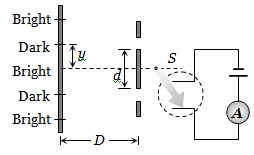
In the following arrangement $y = 1.0\ mm, d = 0.24\ mm$ and $D = 1.2 m.$ The work function of the material of the emitter is $2.2\ eV.$ The stopping potential $V$ needed to stop the photo current will be
Two spheres $A$ and $B$ of radius $'a\ '$ and $' b\ '$ respectively are at same electric potential. The ratio of the surface charge densities of $A$ and $B$ is
A pencil dipped partially in water appears bent because of:
The maximum kinetic energy of the photoelectrons emitted from a surface is dependent on the: