MCQ
Number of nodal centres for $2s$  orbital
  • $1$
  • B
    $0$
  • C
    $4$
  • D
    $3$

Answer

Correct option: A.
$1$
a
(a) Number of nodal centre for $2s$ orbitals $(\,n - 1) = 2 - 1 = 1$.

Need a full question paper?

Generate a complete, print-ready paper with questions like this in minutes — across 16+ boards, with answer keys.
Start Generating Free

Similar questions

Electrolysis of dilute aqueous $\mathrm{NaCl}$ solution was carried out by passing $10$ milli ampere current. The time required to liberate $0.01 \mathrm{~mol}$ of $\mathrm{H}_2$ gas at the cathode is ( $1$ Faraday $=96500 \mathrm{C} \mathrm{mol}^{-1}$ )
Lines of Lyman series of spectrum of hydrogen are in
$92\  gms$ and $32\  gms$ of $NO_2(g)$ and $O_2(g)$ respectivley are taken in a rigid container and at a constant temperature they react to produce $N_2O_5(g)$ . The pressure in the container after the reaction was observed to be $\frac{7}{8}P$ where $P$ is initial pressure of the gasesous mixture. The percentage yield of the reaction is ....$\%$
The equilibrium constant for the given reaction ${H_2} + {I_2}$ $\rightleftharpoons$ $2HI$ is correctly given by expression
The minimum energy a molecule should possess in order to enter into a fruitful collision is known as
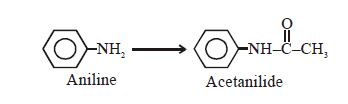
All but one of the following compounds react with Aniline to give acetanilide which one does not ?
A compound $A $ has a molecular formula ${C_2}C{l_3}OH.$ It reduces Fehling solution and on oxidation gives a monocarboxylic acid $(B)$ . $A$   is obtained by action of chlorine on ethyl alcohol. $ A $ is
Two mole of $HBr$ is added with $CH_3 -C$ $ \equiv $ $CH$ in presence of peroxide to give
Which of the following is arranged in decreasing order of size?
$NO_2$ required for a reaction is produced by the decomposition of $N_2O_5$ in $CCl_4$ as per the equation  $2N_2O_5 (g) \to 4NO_2 (g) + O_2 (g)$ The initial concentration of $N_2O_5$ is $3.00\, mol\, L^{-1}$ and it is $2.75\, mol\, L^{-1}$ after $30\, minutes$. The rate of formation of $NO_2$ is ............... $mol\, L^{-1}\, min^{-1}$