MCQ
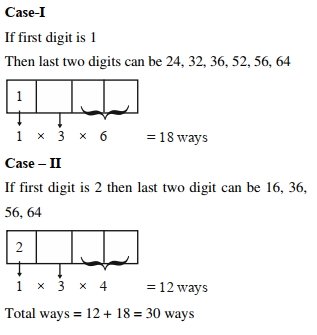
Numbers are to be formed between $1000$ and $3000$, which are divisible by $4$, using the digits $1,2,3,4,5$ and $6$ without repetition of digits. Then the total number of such numbers is.
  • A
    $3$
  • $30$
  • C
    $60$
  • D
    $15$

Answer

Correct option: B.
$30$
b

Need a full question paper?

Generate a complete, print-ready paper with questions like this in minutes — across 16+ boards, with answer keys.

Start Generating Free

Similar questions

If the lines $ax + 12y + 1 = 0, bx + 13y + 1 = 0$ and $cx + 14y + 1 = 0$ are concurrent, then $a, b, c$ are in:
For two independent events $A$ and $B , P ( A + B )$ is equal to :
Let $F_1$ be the set of parallelograms$, F_2$ the set of rectangles$, F_3$ the set of rhombuses$, F_4$ the set of squares and $F_5$ the set of trapeziums in a plane. Then $F_1$ may be equal to$,$
For two non-zero complex number $z_1$ and $z_2$, if $\operatorname{Re}\left(z_1 z_2\right)=0$ and $\operatorname{Re}\left(z_1+z_2\right)=0$, then which of the following are possible ?

$(A)$ $\operatorname{Im}\left(z_1\right) > 0$ and $\operatorname{Im}\left(z_2\right) > 0$

$(B)$ $\operatorname{Im}\left(z_1\right) < 0$ and $\operatorname{Im}\left(z_2\right) > 0$

$(C)$ $\operatorname{Im}\left(z_1\right) > 0$ and $\operatorname{Im}\left(z_2\right) < 0$

$(D)$ $\operatorname{Im}\left( z _1\right) < 0$ and $\operatorname{Im}\left( z _2\right) < 0$

Choose the correct answer from the options given below :

If $A - B =\frac{\pi}{4}$, then $(1+\tan A )(1-\tan B )$ is equal to
Let $A B C$ be a triangle and $M$ be a point on side $A C$ closer to vertex $C$ than $A$. Let $N$ be a point on side $A B$ such that $M N$ is parallel to $B C$ and let $P$ be a point on side $B C$ such that $M P$ is parallel to $A B$. If the area of the quadrilateral $B N M P$ is equal to $\frac{5}{18}$ of the area of $\triangle A B C$, then the ratio $A M / M C$ equals
The middle term in the expansion of $\Big(\frac{2\text{x}}{3}=\frac{3}{2\text{x}^{2}}\Big)^{2\text{n}}$ is:
The difference between the maximum and the minimum obervations in data is called the $...........$
If $a,\;b,\;c,\;d$ are positive, then $\mathop {\lim }\limits_{x \to \infty } {\left( {1 + \frac{1}{{a + bx}}} \right)^{c + dx}} = $
The value of $0.\mathop {234}\limits^{\,\,\, \bullet \,\, \bullet } $ is