Question
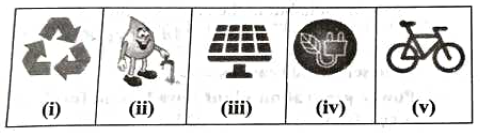
Observe the pictures given below.
Image

Answer

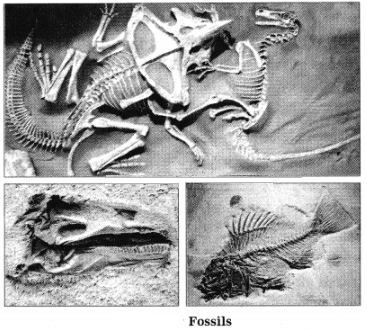
(1) Fossils offer palaeontological evidence for the evolutionary process.
(2) Due to some natural calamities the organisms get buried during ancient times.
(3) The impressions and remnants of such organisms remain preserved underground. The hot lava also traps some organisms or their impressions. All such formations form fossils.
(4) Study of fossils help the researcher to understand the characteristics of the organisms that existed in the.past.
(5) Carbon dating method also helps in finding out exact age of the fossil. According to the structure of earth’s crust the fossils are obtained at specific depths.
(6) The oldest ones are obtained at the depth while the relatively recent ones occupy the upper surface. Thus fossils of invertebrates were seen in very old Palaeozoic era. Later were seen fossils of Pisces, Amphibia and Reptilia. The Mesozoic era was dominated by reptiles while Coenozoic era showed presence of mammals.
(7) In this way, study of fossils unfold the evolutionary secrets.

Need a full question paper?

Generate a complete, print-ready paper with questions like this in minutes — across 16+ boards, with answer keys.
Start Generating Free

Similar questions

Recognize the following food chain Describe the ecosystem to which it belongs.
Grasshopper → snake → Paddy field → Eagle → Frog.
Draw ray diagrams to represent the nature, position and relative size of the image formed by a convex lens for the object placed:
  1. At $2F_1$
  2. between F and the optical centre $O$ of the lens.
Which of the above two cases shows the use of convex lens as a magnifying glass ? Give reasons for your choice.
Write short notes :
Hope's apparatus
What are the objectives of mock drill?
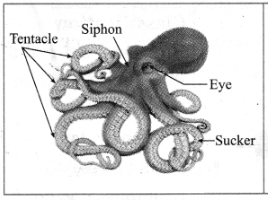
(a) Identify the animal given here.
(b) Write the phylum to which it belongs.
(c) Identify the pointed parts; p, q, r and s.
Image
A student did an experiment with a convex lens. He put an object at different distances 25cm, 30cm, 40cm, 60cm and 120cm from the lens. In each case he measured the distance of the image from the lens. His results were 100cm, 24cm, 60cm, 30cm and 40cm, respectively. Unfortunately his results are written in wrong order:
  1. Rewrite the image distances in the correct order.
  2. What would be the image distance if the object distance was 90cm?
  3. Which of the object distances gives the biggest image?
  4. What is the focal length of this lens?
With the help of suitable diagrams, explain the mitosis in detail.
Explain: In the ecosystem wild animals like lions, tigers, are important.
Balance the following equation stepwise.
Write down the steps in balancing the equation.
$N_{2(g)} + H_{2(g)}\rightarrow NH_{3(g)}.$
Explain the meanings of the following symbols:
Image