Question
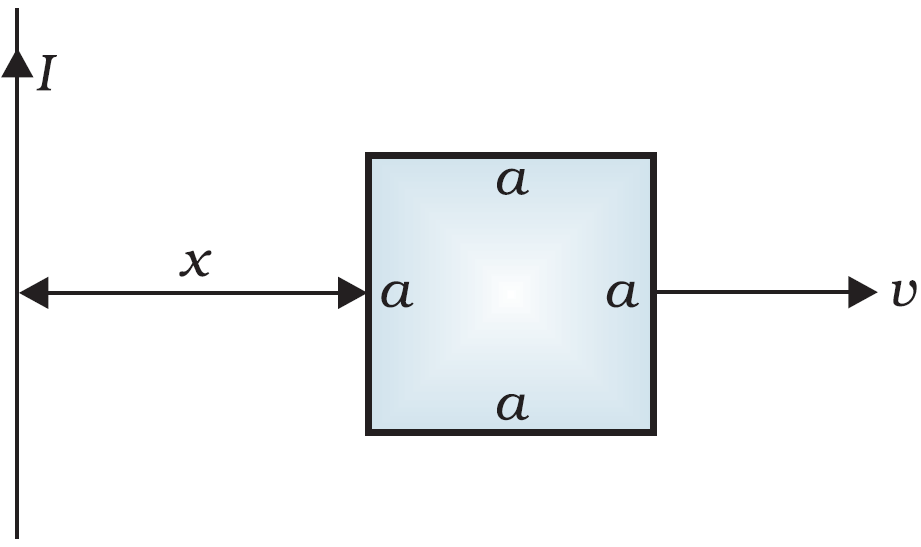
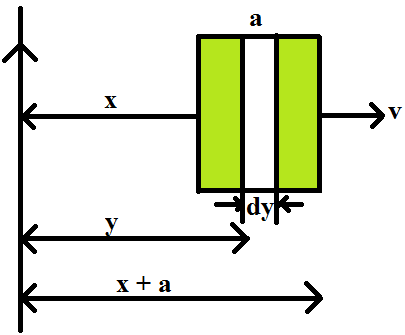
  1. Obtain an expression for the mutual inductance between a long straight wire and a square loop of side a as shown in Fig.
  2. Now assume that the straight wire carries a current of 50A and the loop is moved to the right with a constant velocity, v = 10\m/s. Calculate the induced emf in the loop at the instant when x = 0.2m. Take a = 0.1m and assume that the loop has a large resistance.
Answer

  1. Take a small element dy in the loop at a distance y from the long straight wire (as shown in the given figure).
Magnetic flux associated with element dy, $\text{d}\phi=\text{BdA}$
Where,
dA = Area of element dy = ady
B = Magnetic field at distance y
$=\frac{\mu_0\text{I}}{2\pi\text{y}}\text{s}$
I = Current in the wire
$\mu_0=\text{Permeability of free space}=4\pi\times10^{-7}\text{Tm}\text{A}^{-1}$
$\therefore\ \text{d}\phi=\frac{\mu_0\text{Ia}}{2\pi}\frac{\text{dy}}{\text{y}}\text{s}$
$\phi=\frac{\mu_0\text{Ia}}{2\pi}\int\frac{\text{dy}}{\text{y}}$
y tends from x to a + x.s
$\therefore\ \phi=\frac{\mu_0\text{I}\text{a}^{\text{a}+\text{x}}}{2\pi}\int_{\text{x}}\frac{\text{dy}}{\text{y}}$
$=\frac{\mu_0\text{Ia}}{2\pi}\big[\log_{\text{e}}\text{ y}\big]_{\text{x}}^{\text{a}+\text{x}}$
$=\frac{\mu_0\text{Ia}}{2\pi}\log_{\text{e}}\Big(\frac{\text{a}+\text{x}}{\text{x}}\Big)$
For mutual inductance M, the flux is given as:
$\phi=\text{mI}$
$\therefore\ \text{mI}=\frac{\mu_0\text{Ia}}{2\pi}\log_{\text{e}}\Big(\frac{\text{a}}{\text{x}}+1\Big)$
$\text{m}=\frac{\mu_0\text{a}}{2\pi}\log_{\text{e}}\Big(\frac{\text{a}}{\text{x}}+1\Big)$
  1. Emf induced in the loop, $\text{e}=\text{B}'\text{av}\Big(\frac{\mu_0}{2\pi}\Big)\text{av}$ Given,
I = 50A
x = 0.2m
a = 0.1m
v = 10m/s
$\text{BQv}=\frac{\text{M}\text{v}^2}{\text{r}}$
$\therefore\ \text{B}2\pi\text{r}\lambda\text{r}^2=\frac{\text{Mv}}{\text{r}}$
$\text{v}=\frac{\text{B}2\pi\text{r}\lambda\text{r}^2}{\text{M}}$
$\text{For }\text{r}\leq\text{a}\text{ and }\text{a}<\text{R},\ \text{we get}:$
$(\text{i})=-\frac{2\text{B}_0\text{a}^2\lambda}{\text{MR}}\text{k}$
$e = 5 \times 10^{-5}V$

Need a full question paper?

Generate a complete, print-ready paper with questions like this in minutes — across 16+ boards, with answer keys.

Start Generating Free

Similar questions

  1. Define the term drift velocity.
  2. On the basis of electron drift, derive an expression for resistivity of a conductor in terms of number density of free electrons and relaxation time. On what factors does resistivity of a conductor depend?
  3. Why alloys like constantan and manganin are used for making standard resistors?
$(I)$ Explain briefly, with the help of a labelled diagram, the basic principle of the working of an a.c. generator. In an a.c. generator, coil of $N$ turns and area $A$ is rotated at an angular velocity $ω$ in a uniform magnetic field $B$. Derive an expression for the instantaneous value of the emf induced in coil. What is the source of energy generation in this device?
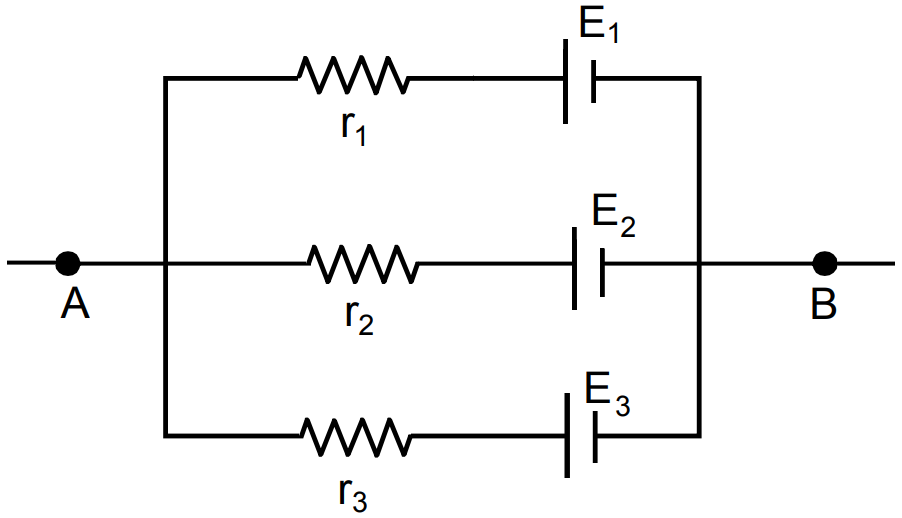
In the circuit shown in the figure. $\in_1=3\text{V},\in_2=2\text{V},\in_3=1\text{V}$ and $\text{r}_1=\text{r}_2=\text{r}_3=1\Omega.$ Find the potential difference between the points A and B and the current through each branch.
Consider the fission of $^{238}_{92}\text{U}$ by fast neutrons. In one fission event, no neutrons are emitted and the final end products, after the beta decay of the primary fragments, are $^{140}_{58}\text{Ce}$ and $^{99}_{44}\text{Ru}.$ Calculate Q for this fission process.
The relevant atomic and particle masses are:
$\text{m}(^{238}_{92}\text{U})=238.05079\text{ u}$
$\text{m}(^{140}_{58}\text{Ce})=139.90543\text{ u}$
$\text{m}(^{99}_{44}\text{Ru})=98.90594\text{ u}$
Answer the following Questions.
  1. Find expressions for the force and torque on an electric dipole kept in a uniform electric field.
OR

An electric dipole is held in a uniform electric field. (i) Using suitable diagram show that it does not undergo any translatory motion, and (ii) derive an expression for torque acting on it and specify its direction.
  1. Derive an expression for the work done in rotating a dipole from the angle $\theta_0$ to $\theta_1$ in a uniform electric field E.
​​​​​​​OR
  1. Define torque acting on a dipole of dipole moment $\vec{\text{p}}$ placed in a uniform electric field $\vec{\text{E}}.$ Express it in the vector form and point out the direction along which it acts.
  2. What happens if the field is non-uniform?
  3. What would happen if the external field $\vec{\text{E}}$ is increasing (i) parallel to $\vec{\text{p}}$ and (ii) anti-parallel to $\vec{\text{p}}?$
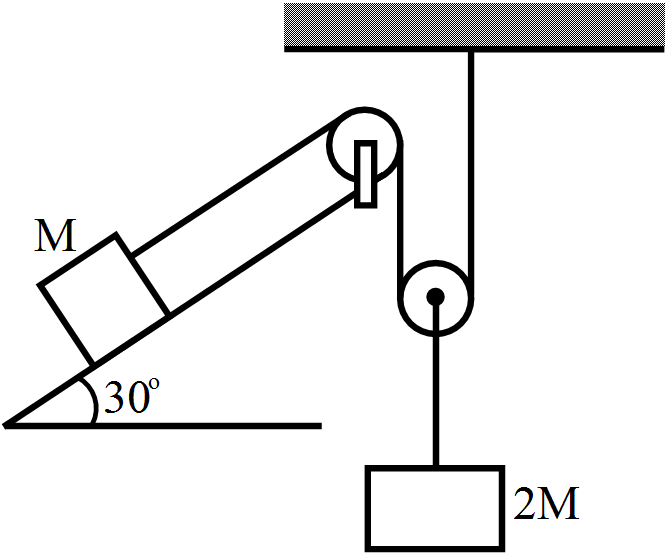
Find the acceleration of the block of mass M in the situation shown in figure. All the surfaces are frictionless and the pulleys and the string are light.
The speed of sound in hydrogen at 0°C is $1280ms^{-1}$. The density of hydrogen at STP is $0.089kg/m^{-3}.$ Calculate the molar heat capacities $C_p$ and $C_v$ of hydrogen.
A parallel-plate capacitor has plate area $25.0cm^2$ and a separation of 2.00mm between the plates. The capacitor is connected to a battery of 12.0V:
  1. Find the charge on the capacitor.
  2. The plate separation is decreased to 1.00mm. Find the extra charge given by the battery to the positive plate.
Repeat the previous problem if the particle C is displaced through a distance x along the line AB.