Question
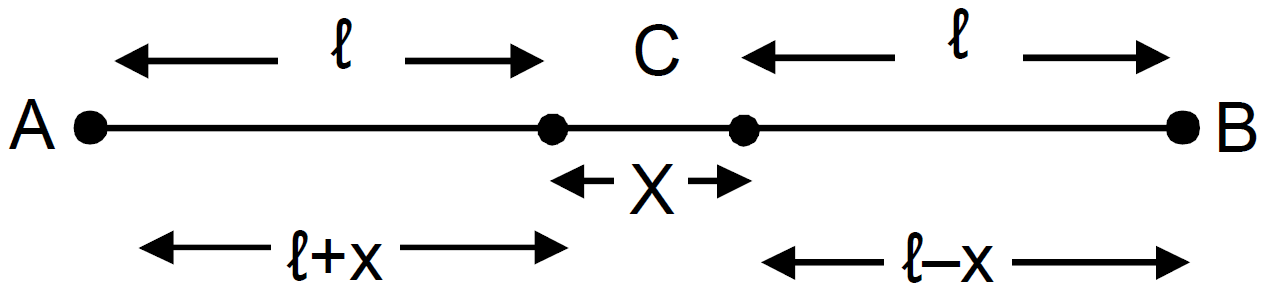
Repeat the previous problem if the particle C is displaced through a distance x along the line AB.
Answer


$\text{F}_\text{AC}=\frac{\text{KQq}}{(\ell+\text{x})^2}$
$\text{F}_\text{CA}=\frac{\text{KQq}}{(\ell-\text{x})^2}$
Net force $=\text{KQq}\Big[\frac{1}{(\ell-\text{x})^2}-\frac{1}{(\ell-\text{x})^2}\Big]$
$=\text{KQq}\bigg[\frac{(\ell+\text{x})^2-(\ell-\text{x})^2}{(\ell+\text{x})^2(\ell-\text{x})^2}\bigg]$
$=\text{KQq}\bigg[\frac{4\ell\text{x}}{(\ell^2-\text{x}^2)^2}\bigg]$
$\text{x}<<<\text{l}=\frac{\text{d}}{2}$ neglecting x w.r.t. $\ell$ We get
net $\text{F}=\frac{\text{KQq}4\ell\text{x}}{\ell^4}=\frac{\text{KQq}4\text{x}}{\ell^3}$ acceleration $=\frac{4\text{KQqx}}{\text{m}\ell^3}$
Time period $=2\pi\sqrt{\frac{\text{displacement}}{\text{acceleration}}}$
$=2\pi\sqrt{\frac{\text{xm}\ell^3}{4\text{KQqx}}}$
$=2\pi\sqrt{\frac{\text{m}\ell^3}{4\text{KQq}}}$
$=\sqrt{\frac{4\pi^2\text{m}\ell^34\pi\in_0}{4\text{Qq}}}$
$=\sqrt{\frac{4\pi^3\text{m}\ell^3\in_0}{\text{Qq}}}$
$=\sqrt{4\pi^3\text{md}^3\in_08\text{Qq}}$
$=\bigg[\frac{\pi^3\text{md}^3\in_0}{2\text{Qq}}\bigg]^{\frac{1}{2}}$

Need a full question paper?

Generate a complete, print-ready paper with questions like this in minutes — across 16+ boards, with answer keys.

Start Generating Free

Similar questions

Explain AC generator by drawing a labelled diagram. Obtain an expression for instantaneous magnitude of induced electromotive force.
A mica strip and a polysterene strip are fitted on the two slits of a double slit apparatus. The thickness of the strips is 0.50mm and the separation between the slits is 0.12cm. The refractive index of mica and polysterene are 1.58 and 1.55 respectively for the light of wavelength 590nm which is used in the experiment. The interference is observed on a screen a distance one meter away.
  1. What would be the fringe-width?
  2. At what distance from the centre will the first maximum be located?
A proton projected in a magnetic field of 0.020T travels along a helical path of radius 5.0cm and pitch 20cm. Find the components of the velocity of the proton along and perpendicular to the magnetic field. Take the mass of the proton $= 1.6 \times 10^{-27}kg$
Draw a labelled diagram of a refracting telescope. Obtain an expression for its magnifying power. Write two main disadvantages of refracting telescope as compared to reflecting telescope. $\#\#\#$ What is meant by telescope? Draw the ray diagram of image formation by a refracting telescope. Briefly describe its working and derive the formula for its magnifying power.
Answer the following questions:
  1. Define electric flux. Write its SI unit.
  2. Using Gauss’s law, prove that the electric field at a point due to a uniformly charged infinite plane sheet is independent of the distance from it.
  3. How is the field directed if:
  • The sheet is positively charged.
  • Negatively charged?
A simple pendulum is constructed by hanging a heavy ball by a 5.0m long string. It undergoes small oscillations.
  1. How many oscillations does it make per second?
  2. What will be the frequency if the system is taken on the moon where acceleration due to gravitation of the moon is $1.67m/s^2.$
The wavelength of sodium light in air is 589nm.
  1. Find its frequency in air.
  2. Find its wavelength in water (refractive index = 1.33).
  3. Find its frequency in water.
  4. Find its speed in water.
Two coherent point sources $S_1$ and $S_2$ vibrating in phase emit light of wavelength $\lambda$. The separation between the sources is $2\lambda$. Consider a line passing through $S_2$ and perpendicular to the line $S_1S_2$. What is the smallest distance from $S_2$ where a minimum of intensity occurs?
Consider a thin target $(10^{-2}m$ square, $10^{-3}m$ thickness$)$ of sodium, which produces a photocurrent of 100μA when a light of intensity $100W/m^2 (\lambda = 660nm)$ falls on it. Find the probability that a photoelectron is produced when a photons strikes a sodium atom. $[$Take density of $Na = 0.97 kg/m^3].$
The electric field at a point associated with a light wave is $\text{E}=\big(100\frac{\text{v}}{\text{m}}\big)\sin[(3.0\times10^{15}\text{s}^{-1})\text{t]sin[(6.0}\times10^{15}\text{s}^{-1})\text{t}].$ If this light falls on a metal surface having a work function of 2.0eV, what will be the maximum kinetic energy of the photoelectrons?