Question
Obtain the magnification by lens after giving the definition.

Answer

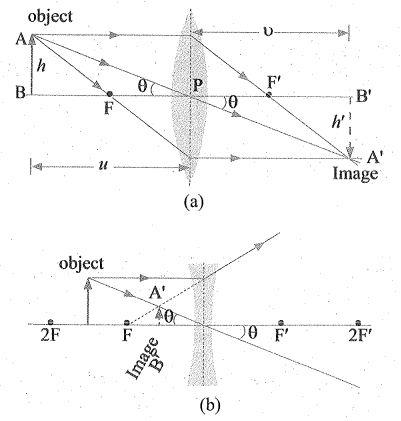
Image
$\rightarrow$ The ratio of the size of the image obtained by lens to that of the object is called magnification.
$m=\frac{h^{\prime}}{h}......(1)$
$\rightarrow$ As shown in figure $AB$ is an object and its image is $A ^{\prime} B ^{\prime}$.
$\rightarrow$ From figure $\triangle ABP$ and $\triangle A ^{\prime} B ^{\prime} P$ are similar triangles.
$\therefore \frac{ A ^{\prime} B ^{\prime}}{ AB }=\frac{ B ^{\prime} P }{ BP }$
$\rightarrow$  But $,  A ^{\prime} B ^{\prime}=-h^{\prime} AB =h$
$ B^{\prime} P =v BP =-u$
$\rightarrow$ Substituting these values in above equation,
$\therefore \frac{-h^{\prime}}{h}=-\frac{v}{u}$
$\therefore \frac{h^{\prime}}{h}=\frac{v}{u}......(2)$
$\rightarrow$ Comparing equation $(1) $ and $(2),$
$\therefore m=\frac{v}{u}$
$\rightarrow$ If the image formed by lens is virtual then magnification $(m)$ is positive and if the image formed by lens is real then magnification $(m)$ is negative.

Need a full question paper?

Generate a complete, print-ready paper with questions like this in minutes — across 16+ boards, with answer keys.
Start Generating Free

Similar questions

A square coil of side 10 cm consists of 20 turns and carries a current of 12 A. The coil is suspended vertically and normal to the plane of the coil makes an angle of $30^{\circ}$with the direction of a uniform horizontal magnetic field of magnitude 0.80 T. What is the magnitude of the torque experienced by the coil?
Identify the following electromagnetic radiations as per the wavelengths given below.
  1. $10^{-3}\ nm$
  2. $10^{-3}m$
  3. $1\ nm$
Write one application of each.

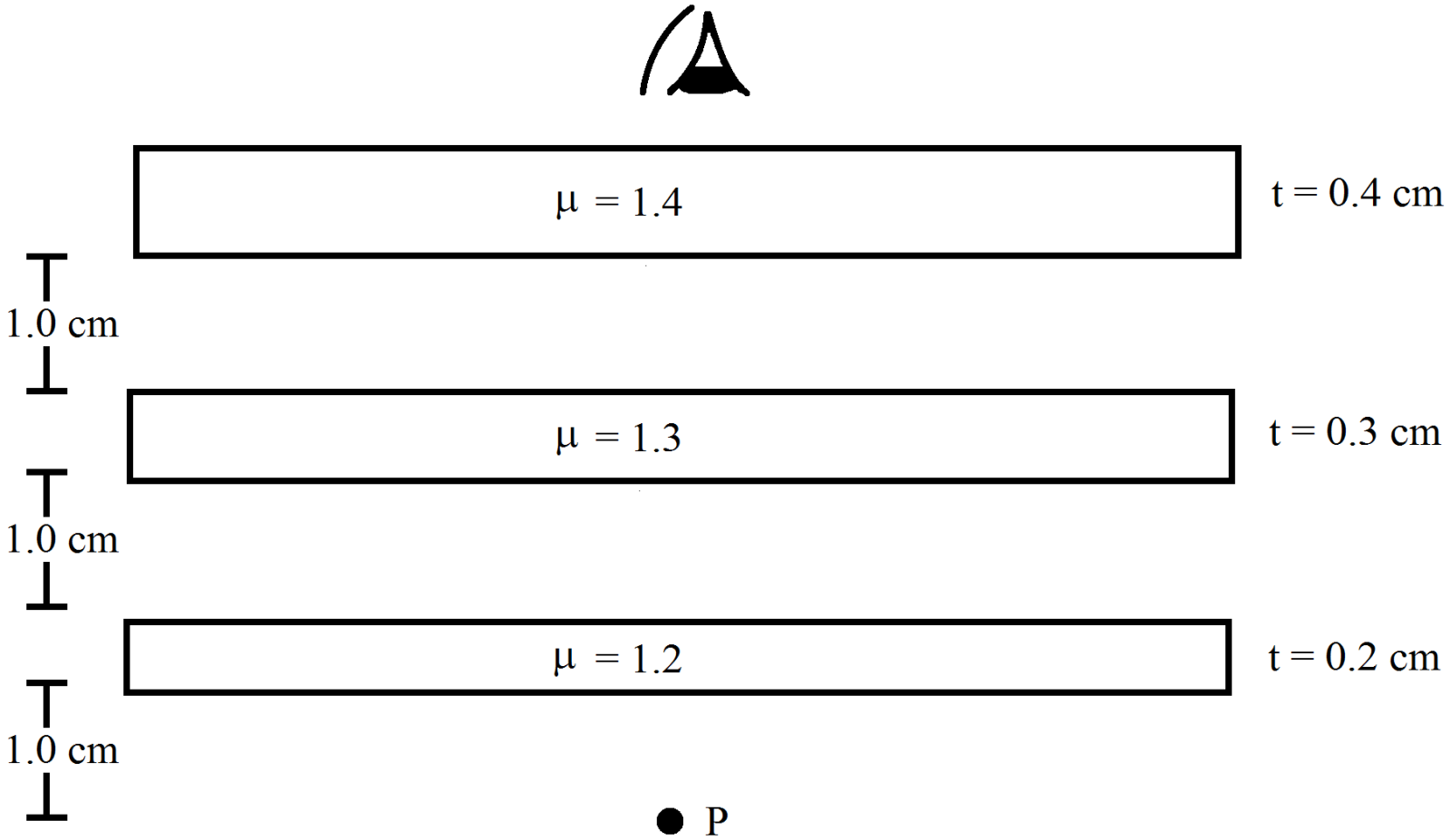
Locate the image of the point P as seen by the eye in the figure.
Magnetic moment of a small bar magnet is 0.24 newton metre tesla ${ }^{-1}$. Calculate magnetising field of the magnet at a distance of 10 cm from the centre of the magnet on its axis.
In Young’s double slit experiment, the two slits are separated by a distance of $1·5 \ mm$ and the screen is placed $1 m$ away from the plane of the slits. A beam of light consisting of two wavelengths $650 \ nm$ and $520 \ nm$ is used to obtain interference fringes. Find.
  1. The distance of the third bright fringe for $\lambda = 520$ nm on the screen from the central maximum.
  2. The least distance from the central maximum where the bright fringes due to both the wavelengths coincide.
A semiconducting material has a band gap of 1eV. Acceptor impurities are doped into it which create acceptor levels 1meV above the valence band. Assume that the transition from one energy level to the other is almost forbidden if kT is less than $\frac{1}{50}$ of the energy gap. Also, if kT is more than twice the gap, the upper levels have maximum population. The temperature of the semiconductor is increased from 0K. The concentration of the holes increases with temperature and after a certain temperature it becomes approximately constant. As the temperature is further increased, the hole concentration again starts increasing at a certain temperature. Find the order of the temperature range in which the hole concentration remains approximately constant.
Write two properties and two uses of X-rays.
A simple pendulum consists of a 50cm long string connected to a 100g ball. The ball is pulled aside so that the string makes an angle of 37° with the vertical and is then released. Find the tension in the string when the bob is at its lowest position.
Using lens maker's formula obtain the equation of lens.
An object is to be seen through a simple microscope of focal length 12cm. Where should the object be placed so as to produce maximum angular magnification? The least distance for clear vision is 25cm.