Question
Using lens maker's formula obtain the equation of lens.

Answer


Image
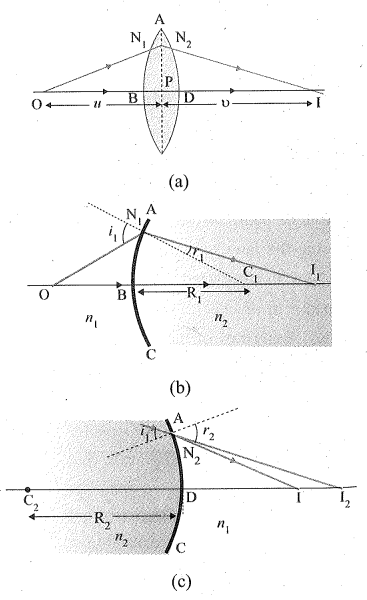
→For refraction at two spherical surfaces of lens,
$\begin{aligned}& \frac{n_1}{ OB }+\frac{n_1}{ DI }=\left(n_2-n_1\right)\left(\frac{1}{ BC _1}+\frac{1}{ DC _2}\right) \\\therefore \quad & n_1\left(\frac{1}{ OB }+\frac{1}{ DI }\right)=\left(n_2-n_1\right)\left(\frac{1}{ BC _1}+\frac{1}{ DC _2}\right) \\\therefore \quad & \frac{1}{ OB }+\frac{1}{ DI }=\left(n_{21}-1\right)\left(\frac{1}{ BC _1}+\frac{1}{ DC _2}\right)\end{aligned}$
→using sign convention,
$OB =-u, DI =v, BC _1= R _1 \text { and } DC _2=- R _2.$
Substituting these values in above equation,
$\therefore-\frac{1}{u}+\frac{1}{v}=\left(n_{21}-1\right)\left(\frac{1}{ R _1}-\frac{1}{ R _2}\right)$            ...(1)
→lens maker's formula,
$\therefore \quad \frac{1}{f}=\left(n_{21}-1\right)\left(\frac{1}{ R _1}-\frac{1}{ R _2}\right)$              ...(2)
→Comparing equation (1) and (2),
$\therefore \frac{1}{v}-\frac{1}{u}=\frac{1}{f}$
→This equation is known as lens equation.
→This equation is true for both convex and concave lens.

Need a full question paper?

Generate a complete, print-ready paper with questions like this in minutes — across 16+ boards, with answer keys.

Start Generating Free

Similar questions

Establish a relationship between electric current and drift velocity. Draw the direction of electron flowing in a circuit by drawing an electric circuit.
In a Coolidge tube, electrons strike the target and stop inside it. Does the target get more and more negatively charged as time passes?
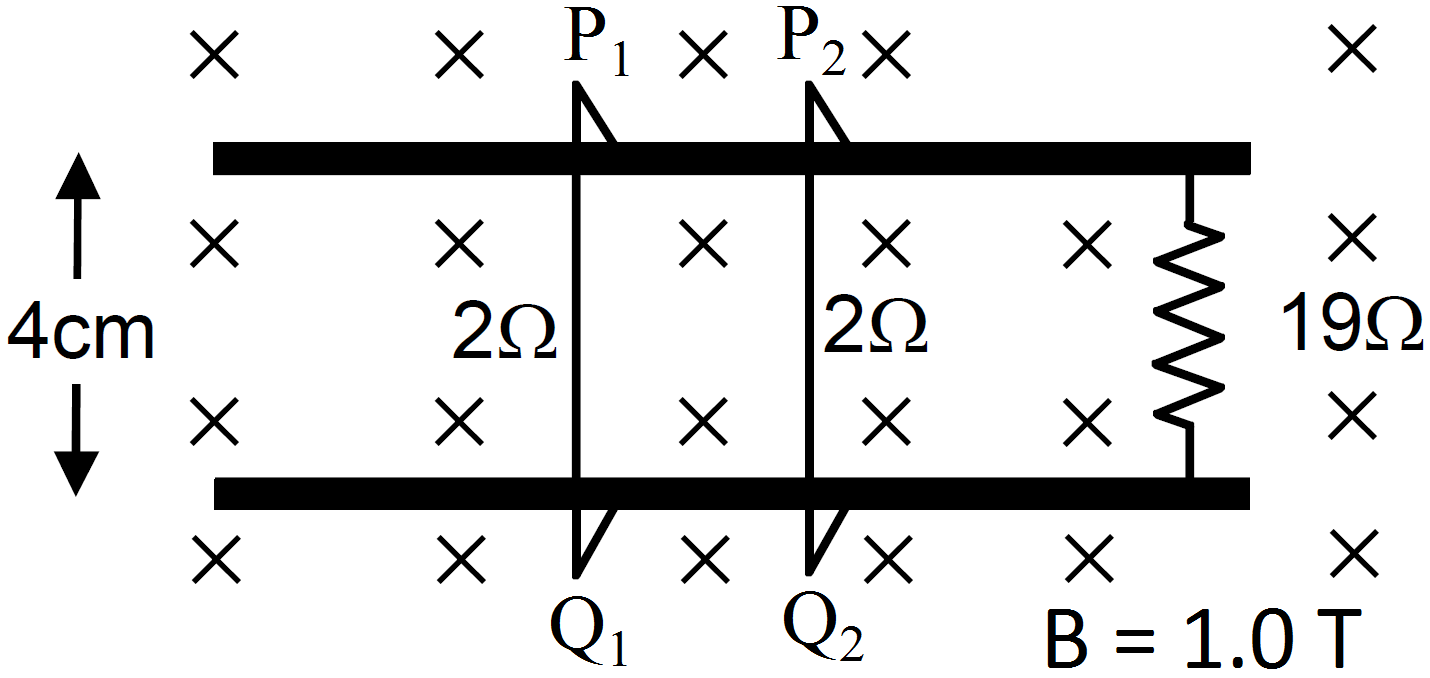
Consider the situation shown in figure. The wires $P_1Q_1$ and $P_2Q_2$ are made to slide on the rails with the same speed $5\ cm/s$. Find the electric current in the $19\Omega$ resistor if:
  1. Both the wires move towards right.
  2. If $P_1Q_1$ moves towards left but $P_2Q_2$ moves towards right.
Calculate the maximum kinetic energy of the beta particle emitted in the following decay scheme:
$\text{ }^{12}\text{N}\rightarrow{ }^{12}\text{C}^*+\text{e}^++\text{v}$
$\text{ }^{12}\text{C}^*\rightarrow\text{ }^{12}\text{C}+\gamma(4.43\text{MeV}).$
The atomic mass of $^{12}N$ is $12.018613u.$
Explain the construction of refracting telescope by figure and obtain the equation of magnification.
Careful measurement of the electric field at the surface of a black box indicates that the net outward flux through the surface of the box is $8.0 \times 103\ Nm^2 / C.$
  1. What is the net charge inside the box?
  2. If the net outward flux through the surface of the box were zero, could you conclude that there were no charges inside the box? Why or Why not?
(a) A current-carrying circular loop lies on a smooth horizontal plane. Can a uniform magnetic field be set up in such a manner that the loop turns around itself (i.e., turns about the vertical axis).
(b) A current-carrying circular loop is located in a uniform external magnetic field. If the loop is free to turn, what is its orientation of stable equilibrium? Show that in this orientation, the flux of the total field (external field + field produced by the loop) is maximum.
(c) A loop of irregular shape carrying current is located in an external magnetic field. If the wire is flexible, why does it change to a circular shape?
Can we find the mass of a photon by the definition p = mv?
A hollow charged conductor has a tiny hole cut into its surface. Show that the electric field in the hole is $(\sigma /2ε_0) \hat{\text{n}}$ , where $\hat{\text{n}}$ is the unit vector in the outward normal direction, and $\sigma$ is the surface charge density near the hole.
A particle goes in a circle of radius 2.0cm. A concave mirror of focal length 20cm is placed with its principal axis passing through the centre of the circle and perpendicular to its plane. The distance between the pole of the mirror and the centre of the circle is 30cm. Calculate the radius of the circle formed by the image.