MCQ
Ohm's law is true
  • For metallic conductors at low temperature
  • B
    For metallic conductors at high temperature
  • C
    For electrolytes when current passes through them
  • D
    For diode when current flows

Answer

Correct option: A.
For metallic conductors at low temperature
a
(a) Because with rise in temperature resistance of conductor increase, so graph between $V$ and $i$ becomes non linear.

Need a full question paper?

Generate a complete, print-ready paper with questions like this in minutes — across 16+ boards, with answer keys.
Start Generating Free

Similar questions

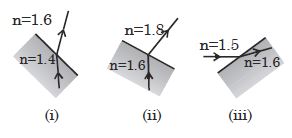
Which of the following ray diagram shows physically possible refraction ?
Fission of nuclei is possible because the binding energy per nucleon in them
Total internal reflection is possible when light rays travel
If the distance between the first maxima and fifth minima of a double slit pattern is $7\,mm$ and the slits are separated by $0.15\,mm$ with the screen $50\,cm$. from the slits, then find the wavelength of the light used $............\,nm$
The effective capacitances of two capacitors are $3\,\mu F$ and $16\,\mu F$, when they are connected in series and parallel respectively. The capacitance of two capacitors are
When two magnetic moments are compared using equal distance method the deflections produced are $45^{\circ}$ and $30^{\circ}$. If the length of magnets are in the ratio 1 : 2, the ratio of their pole strengths is
The inward and outward electric flux for a closed surface in units of $N-m^2/C$ are respectively $8\times10^3$ and $4\times10^3$ Then the total charge inside the surface is [where $\varepsilon_0$ = permittivity constant]
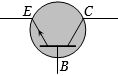
The symbol given in figure represents
A star emitting radiation at a wavelength of $5000 \;\mathring A $ is approaching earth with a velocity of $1.5 \times {10^6}m/s$. The change in wavelength of the radiation as received on the earth, is.......$ \mathring A$
The magnetic moment of a current carrying loop is $2.1 \times 10^{-25} \mathrm{amp} \times \mathrm{m}^2$. The magnetic field at a point on its axis at a distance of 1 $A^0$ is