On a frictionless horizontal plane, a bob of mass $m=0.1 kg$ is attached to a spring with natural length $l_0=0.1 m$. The spring constant is $k_1=0.009 Nm ^{-1}$ when the length of the spring $I > l_0$ and is $k_2=0.016 Nm ^{-1}$ when $ I < l_0$. Initially the bob is released from $l=0.15 m$. Assume that Hooke's law remains valid throughout the motion. If the time period of the full oscillation is $T=(n \pi) s$, then the integer closest to $n$ is. . . . .
IIT 2022, Advanced
Download our app for free and get started
$\ell > \ell_0 \rightarrow k=k_1$
$\ell < \ell_0 \rightarrow k=k_2$
Time period of oscillation,
$T=\pi \sqrt{\frac{ m }{ k _1}}+\pi \sqrt{\frac{ m }{ k _2}}$
$T=\pi \sqrt{\frac{0.1}{0.009}}+\pi \sqrt{\frac{0.1}{0.016}}$
$T =\frac{\pi}{0.3}+\frac{\pi}{0.4} \Rightarrow T=\frac{0.7}{0.12} \pi \Rightarrow T=5.83 \pi$
$T\approx 6 \pi$
So, $n=6$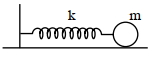

Download our appand get started for free
Experience the future of education. Simply download our apps or reach out to us for more information. Let's shape the future of learning together!No signup needed.*
Similar Questions
- 1A particle of mass $m$ moves in a one-dimensional potential energy $U(x) = -ax^2 + bx^4,$ where $'a'$ and $'b'$ are positive constants. The angular frequency of small oscillations about the minima of the potential energy is equal toView Solution
- 2If $x = a\sin \left( {\omega t + \frac{\pi }{6}} \right)$ and $x' = a\cos \omega t$, then what is the phase difference between the two wavesView Solution
- 3In forced oscillation of a particle the amplitude is maximum for a frequency $\omega_{1}$ of the force, while the energy is maximum for a frequency $\omega_{2}$ of the force, thenView Solution
- 4If the displacement of a particle executing $SHM $ is given by $y = 0.30\sin (220t + 0.64)$ in metre, then the frequency and maximum velocity of the particle isView Solution
- 5An object of mass $0.5\, {kg}$ is executing simple harmonic motion. Its amplitude is $5\, {cm}$ and time period (T) is $0.2\, {s} .$ What will be the potential energy of the object at an instant $t=\frac{T}{4}$ s starting from mean position. Assume that the initial phase of the oscillation is zero. (In ${J}$)View Solution
- 6A particle performs $S.H.M.$ of amplitude $A$ with angular frequency $\omega$ along a straight line. Whenit is at a distance $\frac{{\sqrt 3 }}{2}$ $A$ from mean position, its kinetic energy gets increased by an amount $\frac{1}{2}m{\omega ^2}{A^2}$ due to an impulsive force. Then its new amplitude becomesView Solution
- 7A particle is performing $S.H.M.$ with energy of vibration $90 \,J$ and amplitude $6 \,cm$. When the particle reaches at distance $4 \,cm$ from mean position, it is stopped for a moment and then released. The new energy of vibration will be ........... $J$View Solution
- 8A particle is executing Simple Harmonic Motion $(SHM)$. The ratio of potential energy and kinetic energy of the particle when its displacement is half of its amplitude will beView Solution
- 9The amplitude of a particle executing $SHM$ is $4 \,cm$. At the mean position the speed of the particle is $16\, cm/sec$. The distance of the particle from the mean position at which the speed of the particle becomes $8\sqrt 3 \,cm/s,$ will be .... $cm$View Solution
- 10Two masses $m_1$ and $m_2$ are supended together by a massless spring of constant $k$. When the masses are in equilibrium, $m_1$ is removed without disturbing the system; the amplitude of vibration isView Solution