If $x = a\sin \left( {\omega t + \frac{\pi }{6}} \right)$ and $x' = a\cos \omega t$, then what is the phase difference between the two waves
Medium


Download our appand get started for free
Experience the future of education. Simply download our apps or reach out to us for more information. Let's shape the future of learning together!No signup needed.*
Similar Questions
- 1A simple pendulum executing $S.H.M.$ is falling freely along with the support. ThenView Solution
- 2The length of simple pendulum is increased by $44\%$. The percentage increase in its time period will be ..... $\%$View Solution
- 3Two particles execute $SHM$ of same amplitude of $20\, cm$ with same period along the same line about the same equilibrium position. The maximum distance between the two is $20\, cm.$ Their phase difference in radians isView Solution
- 4The kinetic energy of $SHM$ is $1/n$ time its potential energy. If the amplitude of the $SHM$ be $A$, then what is the displacement of the particle?View Solution
- 5The phase difference between two $SHM\,\,$ ${y_1}\, = \,10\,\sin \,\left( {10\pi t\, + \,\frac{\pi }{3}} \right)$ and ${y_2}\, = \,12\,\sin \,\left( {8\pi t\, + \,\frac{\pi }{4}} \right)$ at $t = 0.5\,s$ itView Solution
- 6Two particles are executing simple harmonic motion of the same amplitude $A$ and frequency $\omega $ along the $x-$ axis. Their mean position is separated by distance $X_0 (X_0> A)$. If the maximum separation between them is $(X_0 +A)$, the phase difference between their motion isView Solution
- 7One end of a spring of force constant k is fixed to a vertical wall and the other to a block of mass m resting on a smooth horizontal surface. There is another wall at a distance ${x_0}$ from the black. The spring is then compressed by $2{x_0}$ and released. The time taken to strike the wall isView Solution
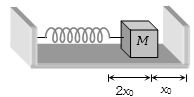
- 8A particle is performing simple harmonic motion along $x$ -axis with amplitude $4\, cm$ and time period $1.2\, sec$. The minimum time taken by the particle to move from $x = 2\, cm$ to $x =+ 4 \,cm$ and back again is given by .... $s$View Solution
- 9A particle executes simple harmonic motion with an amplitude of $5\, cm$. When the particle is at $4\, cm$ from the mean position, the magnitude of its velocity is $SI\,units$ is equal to that of its acceleration. Then, its periodic time in seconds isView Solution
- 10A simple pendulum with iron bob has a time period $T$. The bob is now immersed in a non-viscous liquid and oscillated. If the density of liquid is $\frac{1}{12}$ th that of iron, then new time period will beView Solution