MCQ
On heating a liquid, the refractive index generally
  • Decreases
  • B
    Increases or decreases depending on the rate of heating
  • C
    Does not change
  • D
    Increases

Answer

Correct option: A.
Decreases
Decreases

Need a full question paper?

Generate a complete, print-ready paper with questions like this in minutes — across 16+ boards, with answer keys.

Start Generating Free

Similar questions

A body takes 5 minute to cool from $80^{\circ} \mathrm{C}$ to $50^{\circ} \mathrm{C}$. How much time it will take to cool from $60^{\circ} \mathrm{C}$ to $30^{\circ} \mathrm{C}$, if room temperature is $20^{\circ} \mathrm{C}$.
The internal energy of an ideal gas depends upon
The length of an iron wire is $L$ and area of cross-section is $A$. The increase in length is $l$ on applying the force $F$ on its two ends. Which of the statement is correct
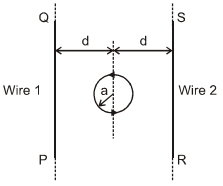
The figure shows a circular loop of radius a with two long parallel wires (numbered $1$ and $2$) all in the plane of the paper. The distance of each wire from the centre of the loop is $d$. The loop and the wires are carrying the same current $I$. The current in the loop is in the counterclockwise direction if seen from above.$Image$

$1.$ When $d \approx$ a but wires are not touching the loop, it is found that the net magnetic filed on the axis of the loop is zero at a height $h$ above the loop. In that case

$(A)$ current in wire $1$ and wire $2$ is the direction $P Q$ and $R S$, respectively and $h \approx a$

$(B)$ current in wire $1$ and wire $2$ is the direction $PQ$ and $SR$, respectively and $h \approx a$

$(C)$ current in wire $1$ and wire $2$ is the direction $PQ$ and $SR$, respectively and $h \approx 1.2 a$

$(D)$ current in wire $1$ and wire $2$ is the direction $PQ$ and $RS$, resepectively and $h \approx 1.2 a$

$2.$ Consider $d \gg a$, and the loop is rotated about its diameter parallel to the wires by $30^{\circ}$ from the position shown in the figure. If the currents in the wires are in the opposite directions, the torque on the loop at its new position will be (assume that the net field due to the wires is constant over the loop)

$(A)$ $\frac{\mu_0 I^2 a^2}{d}$ $(B)$ $\frac{\mu_0 I^2 a^2}{2 d}$ $(C)$ $\frac{\sqrt{3} \mu_0 I^2 a^2}{d}$ $(D)$ $\frac{\sqrt{3} \mu_0 I^2 a^2}{2 d}$

Give the answer question $1$ and $2.$
Consider the three waves $z_1, z_2$ and $z_3$ as $z_1=A \sin (k x-\omega t), z_2=A \sin (k x+\omega t)$ and $z_3=A \sin (k y-\omega t)$. Which of the following represents a standing wave
A lead bullet at $27^{\circ} \mathrm{C}$ just melts when stopped by an obstacle. Assuming that $25 \%$ of heat is absorbed by the obstacle, then the velocity of the bullet at the time of striking (M.P. of lead $=327^{\circ} \mathrm{C}$, specific heat of lead $=0.03\  \mathrm{callgm}{ }^{\circ} C$, latent heat of fusion of lead $=6$ callgm and $J=4.2$ joule $/ \mathrm{cal}$ )
A system performs work $\Delta W$ when an amount of heat is $\Delta Q$ added to the system, the corresponding change in the internal energy is $\Delta U$. A unique function of the initial and final states (irrespective of the mode of change) is
Some electric bulbs are connected in series across a $220 V$ supply in a room. If one bulb is fused then remaining bulbs are connected again in series across the same supply. The illumination in the room will
Two points separated by a distance of $0.1 \mathrm{~mm}$ can just be resolved in a microscope when a light of wavelength $6000 \mathring A$ is used. If the light of wavelength $4800 \mathring A$ is used this limit of resolution becomes
A current of $1.5 A$ flows through a copper voltameter. The thickness of copper deposited on the electrode surface of area $50 cm ^2$ in 20 minutes will be (Density of copper $=9000 kg / m ^3$ and E.C.E. of copper $=0.00033 g / C )$