Question
On increasing the current drawn from a cell, the net potential difference across its terminals is lowered, why?
Answer

The terminal potential difference V = E - Ir.
Clearly if I is increased, the terminal potential difference falls.

Need a full question paper?

Generate a complete, print-ready paper with questions like this in minutes — across 16+ boards, with answer keys.

Start Generating Free

Similar questions

You are given a low resistance $R_1$, a high resistance $R_2$ and a galvanometer. How will you make such instruments from them which can measure (i) current, (ii) potential difference?
Magnetic flux passing through plane of any coil is changing with time according to the relation $\phi=$ $\left(5 t^3+4 t^2+2 t-5\right) Wb$. Find the induced current in the coil at $t=2$ seconds given that resistance of the coil is 5 ohms.
Write the formula to find the Rydberg's constant and what is the value of their constant?
The angle made by the string of a simple pendulum with the vertical depends on time as $\theta=\frac{\pi}{90}\sin[(\pi\text{s}^{-1})\text{t}].$ Find the length of the pendulum if $\text{g}=\pi^2\text{m/s}^2.$
If a constant potential difference is applied across a bulb, the current slightly decreases as time passes and then becomes constant. Explain.
White light is used in a Young's double slit experiment. Find the minimum order of the violet fringe $(\lambda=400\text{nm}),$ which overlaps with a red fringe $(\lambda=700\text{nm}).$
Evaluate Rydberg constant by putting the values of the fundamental constants in its expression.
A current of 10A is established in a long wire along the positive z-axis. Find the magnetic field $\overrightarrow{\text{B}}$ at the point (1m, 0, 0).
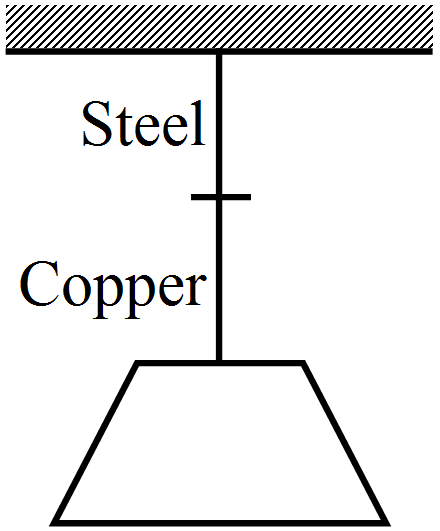
In the upper wire is made of steel and the lower of copper. The wires have equal cross-section. Find the ratio of the longitudinal strains developed in the two wires.

A molecule of a substance has a permanent electric dipole moment of magnitude $10^{-29} C m$. A mole of this substance is polarised (at low temperature) by applying a strong electrostatic field of magnitude $10^6 V m ^{-1}$. The direction of the field is suddenly changed by an angle of $60^{\circ}$. Estimate the heat released by the substance in aligning its dipoles along the new direction of the field. For simplicity, assume $100 \%$ polarisation of the sample.