MCQ
On the Celsius scale the absolute zero of temperature is at
  • A
    $0^{\circ} \mathrm{C}$
  • B
    $-32^{\circ} \mathrm{C}$
  • C
    $100^{\circ} \mathrm{C}$
  • $-273.15^{\circ} \mathrm{C}$

Answer

Correct option: D.
$-273.15^{\circ} \mathrm{C}$
$ T=273.15+t^{\circ} \mathrm{C} \Rightarrow 0=273.15+t^{\circ} \mathrm{C} $
$ \Rightarrow t=-273.15^{\circ} \mathrm{C}$

Need a full question paper?

Generate a complete, print-ready paper with questions like this in minutes — across 16+ boards, with answer keys.
Start Generating Free

Similar questions

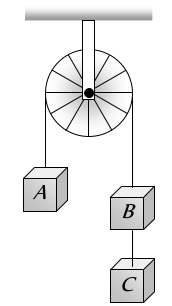
Three equal weights $A, B$ and $C$ of mass $2 kg$ each are hanging on a string passing over a fixed frictionless pulley as shown in the figure The tension in the string connecting weights $B$ and $C$ is
Four pieces of iron heated in a furnace to different temperatures show different colours listed below. Which one has the highest temperature
The radii of two planets are respectively $R_1$ and $R_2$ and their densities are respectively $\rho_1$ and $\rho_2$. The ratio of the accelerations due to gravity at their surfaces is
A body is projected vertically upwards from the surface of a planet of radius $R$ with a velocity equal to half the escape velocity for that planet. The maximum height attained by the body is
Two cars are moving in the same direction with the same speed 30 $km / hr$. They are separated by a distance of $5 km$, the speed of a car moving in the opposite direction if it meets these two cars at an interval of 4 minutes, will be
The acceleration due to gravity at a place is $\pi^2 m / sec ^2$. Then the time period of a simple pendulum of length one metre is
A torch battery consisting of two cells of 1.45 volts and an internal resistance $0.15 \Omega$, each cell sending currents through the filament of the lamps having resistance $1.5 \mathrm{ohms}$. The value of current will be
The focal length of a concave mirror is $50 \mathrm{~cm}$. Where an object be placed so that its image is two times and inverted
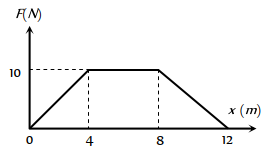
A particle of mass $0.1 \mathrm{~kg}$ is subjected to a force which varies with distance as shown in fig. If it starts its journey from rest at $x=0$, its velocity at $x=12 \mathrm{~m}$ is
Image
A body of mass $m$ moving with velocity $v$ collides head on with another body of mass $2 \mathrm{~m}$ which is initially at rest. The ratio of K.E. of colliding body before and after collision will be