On the superposition of two harmonic oscillations represented by ${x_1} = a\,\sin \,\left( {\omega t + {\phi _1}} \right)$ and ${x_2} = a\,\sin \,\left( {\omega t + {\phi _2}} \right)$ a resulting oscillation with the same time period and amplitude is obtained. The value of ${\phi _1} - {\phi _2}$ is .... $^o$
Medium


Download our appand get started for free
Experience the future of education. Simply download our apps or reach out to us for more information. Let's shape the future of learning together!No signup needed.*
Similar Questions
- 1The instantaneous displacement of a simple pendulum oscillator is given by $x = A\,\cos \,\left( {\omega t + \frac{\pi }{4}} \right)$ . Its speed will be maximum at timeView Solution
- 2A pendulum bob is swinging in a vertical plane such that its angular amplitude is less than $90^o$. At its highest point, the string is cut. Which trajectory is possible for the bob afterwards.View Solution
- 3As a body performs $S.H.M.$, its potential energy $U.$ varies with time as indicated inView Solution
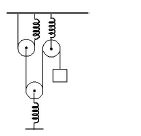
- 4Assuming all pulleys, springs and string massless. Consider all surface smooth. Choose the correct statement $(s)$View Solution
- 5A rectangular block of mass $m$ and area of cross-section $A$ floats in a liquid of density $\rho $. If it is given a small vertical displacement from equilibrium it undergoes with a time period $T,$ thenView Solution
- 6The angular amplitude of a simple pendulum is $\theta_0$. The maximum tension in its string will beView Solution
- 7The displacement of an oscillator is given by $x = a\, \sin \, \omega t + b\, \cos \, \omega t$. where $a, b$ and $\omega$ are constant. Then :-View Solution
- 8A body oscillates with a simple harmonic motion having amplitude $0.05\, m .$ At a certain instant, its displacement is $0.01\, m$ and acceleration is $1.0 \,m / s ^{2} .$ The period of oscillation isView Solution
- 9A horizontal platform with an object placed on it is executing $S.H.M$. in the vertical direction. The amplitude of oscillation is $3.92 \times {10^{ - 3}}m$. What must be the least period of these oscillations, so that the object is not detached from the platformView Solution
- 10View SolutionA flat horizontal board moves up and down in $SHM$ of amplitude $\alpha$. Then the shortest permissible time period of the vibration such that an object placed on the board may not lose contact with the board is