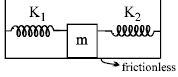
One-forth length of a spring of force constant $K$ is cut away. The force constant of the remaining spring will be
Medium


Download our appand get started for free
Experience the future of education. Simply download our apps or reach out to us for more information. Let's shape the future of learning together!No signup needed.*
Similar Questions
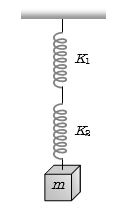
- 1A mass $M$ is suspended by two springs of force constants $K_1$ and $K_2$ respectively as shown in the diagram. The total elongation (stretch) of the two springs isView Solution
- 2In the reported figure, two bodies $A$ and $B$ of masses $200\, {g}$ and $800\, {g}$ are attached with the system of springs. Springs are kept in a stretched position with some extension when the system is released. The horizontal surface is assumed to be frictionless. The angular frequency will be $.....\,{rad} / {s}$ when ${k}=20 \,{N} / {m} .$View Solution

- 3For a simple harmonic motion in a mass spring system shown, the surface is frictionless. When the mass of the block is $1\,kg$, the angular frequency is $\omega_1$. When the mass block is $2\,kg$ the angular frequency is $\omega_2$. The ratio $\omega_2 / \omega_1$ isView Solution
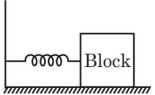
- 4View SolutionIn simple harmonic motion, the ratio of acceleration of the particle to its displacement at any time is a measure of
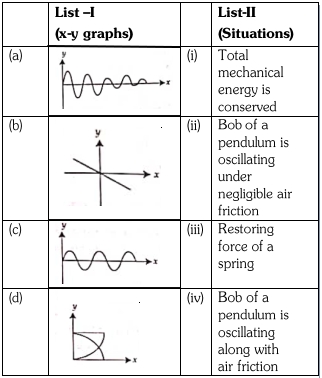
- 5Match $List - I$ with $List - II$View Solution
Choose the correct answer from the options given below
- 6A simple pendulum consisting of a light inextensible string of length $\ell$ attached to a heavy small bob of mass $m$ is at rest. The bob is imparted a horizontal impulsive force which gives it a speed of $\sqrt{4 g \ell}$. The speed of the bob at its highest point is ( $g$ is the accelaration due to gravity)View Solution
- 7If a body of mass $0.98\, kg$ is made to oscillate on a spring of force constant $4.84\, N/m$, the angular frequency of the body is ..... $ rad/s$View Solution
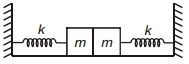
- 8View SolutionAn assembly of identical spring-mass systems is placed on a smooth horizontal surface as shown. At this instant, the springs are relaxed. The left mass is displaced to the/left and theiright mass is displaced to the right by same distance and released. The resulting collision is elastic. The time period of the oscillations of system is
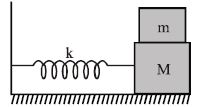
- 9In the arrangement, spring constant $k$ has value $2\,N\,m^{-1}$ , mass $M = 3\,kg$ and mass $m = 1\,kg$ . Mass $M$ is in contact with a smooth surface. The coefficient of friction between two blocks is $0.1$ . The time period of $SHM$ executed by the system isView Solution
- 10Two springs with negligible masses and force constant of $K_1 = 200\, Nm^{-1}$ and $K_2 = 160\, Nm^{-1}$ are attached to the block of mass $m = 10\, kg$ as shown in the figure. Initially the block is at rest, at the equilibrium position in which both springs are neither stretched nor compressed. At time $t = 0,$ a sharp impulse of $50\, Ns$ is given to the block with a hammer.View Solution