MCQ
One watt is equal to __________?
- AOne kilowatt per second.
- BOne kilo joule per second.
- COne joule per second.
- DOne joule per minute.
Explanation:
Watt is the SI unit of power.
$\text{Power}=\frac{\text{Work done}}{\text{time}}$.
The SI unit of work done is the same as energy, that is, joule and that of time is seconds. Therefore, one watt is equal to one joule per second.
Generate a complete, print-ready paper with questions like this in minutes — across 16+ boards, with answer keys.
For non-conductors, the energy gap is
|
(a) 6 eV |
(b) 1.1 eV |
(c) 0.8 eV |
(d) 0.3 eV |
A beam of light AO is incident on a glass slab (μ = 1.54) in a direction as shown in figure. The reflected ray OB is passed through a Nicol prism on viewing through a Nicole prism, we find on rotating the prism that

|
(a) The intensity is reduced down to zero and remains zero |
|
(b) The intensity reduces down some what and rises again |
|
(c) There is no change in intensity |
|
(d) The intensity gradually reduces to zero and then again increases |
The variation of anode current in a triode corresponding to a change in grid potential at three different values of the plate potential is shown in the diagram. The mutual conductance of the triode is
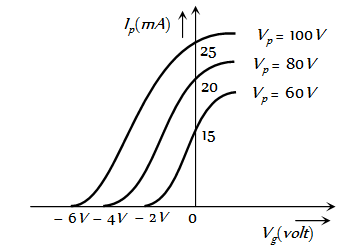
| (a) 2.5 m mho | (b) 5.0 m mho |
(c) 7.5 m mho |
(d) 10.0 m mho |
Two thin lenses of focal lengths 20 cm and 25 cm are placed in contact convex. The effective power of the combination is
|
(a) 45 dioptres |
(b) 9 dioptres |
(c) 1/9 dioptre |
(d) 6 dioptres |
Which of the following is true for number of spectral lines in going form Layman series to Pfund series
|
(a) Increases |
(b) Decreases |
|
(c) Unchanged |
(d) May decreases or increases |