MCQ
One yard in Sl units is equal
  • A
    1.9144 metre
  • 0.9144 metre
  • C
    0.09144 kilometre
  • D
    1.0936 kilometre

Answer

Correct option: B.
0.9144 metre
(b) 1 yard $=36$ inches $=36 \times 2.54 \mathrm{~cm}=0.9144 \mathrm{~m}$.

Need a full question paper?

Generate a complete, print-ready paper with questions like this in minutes — across 16+ boards, with answer keys.

Start Generating Free

Similar questions

A space craft of mass $M$ is moving with velocity $V$ and suddenly explodes into two pieces. A part of it of mass $m$ becomes at rest, then the velocity of other part will be
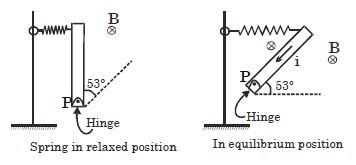
A thin uniform rod with negligible mass and length $l$ is attached to the floor by a frictionless hinge at point $P$ . A horizontal spring with force constant $k$ connects the other end to wall. The rod is in a uniform magnetic field $B$ directed into the plane of paper. What is extension in spring in equilibrium when a current $i$ is passed through the rod in direction shown. Assuming spring to be in natural length initially.
The resistance of $10$ metre long potentiometer wire is $1 \mathrm{ohm} /$ meter: A cell of e.m.f. $2.2$ volts and a high resistance box are connected in series to this wire. The value of resistance taken from resistance box for getting potential gradient of $2.2$ millivolt/metre will be
When a tuning fork of frequency $341$ is sounded with another tuning fork, six beats per second are heard. When the second tuning fork is loaded with wax and sounded with the first tuning fork, the number of beats is two per second. The natural frequency of the second tuning fork is
Which one of the following is known as Saptarishi
The Young's modulus of a rubber string $8 cm$ long and density $1.5 kg / m ^3$ is $5 \times 10^8 N / m ^2$, is suspended on the ceiling in a room. The increase in length due to its own weight will be
A spring balance is graduated on sea level. If a body is weighed with this balance at consecutively increasing heights from earth's surface, the weight indicated by the balance
According to Hubble's law, the redshift $(Z)$ of a receding galaxy and its distance $r$ from earth are related as
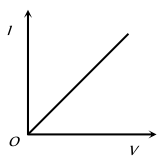
$L V$ characteristic of a copper wire of length $L$ and area of crosssection $A$ is shown in figure. The slope of the curve becomes
Image
Of the diodes shown in the following diagrams, which one is reverse biased