Question
Origin and Evolution of Man:

Answer

→ About 15 mya primates such as Dryopithecus and Ramapithecus existed.
→ They appeared to be similar to Gorillas and Chimpanzees in their appearance and walking.
→ Ramapithecus was more similar to man whereas Dryopithecus was more similar to apes.
→ Few fossils of bones that resemble human bones have been discovered in Ethiopia and Tanzania.
→ The skull of a child Chimpanzee is more similar to that of an adult human than that of an adult chimpanzee.
→ These human-like features further support the belief that 3-4 million years ago human-like primates roamed East Africa.
→ They were probably 4 feet tall or less, but could walk upright.
→ Australopithecines:
→ Two mya Australopithecines existed. They most likely lived in East African grasslands.
→ They used stone weapons for hunting.
→ Essentially had a fruit-based diet. They also survived on plant-based diet and did not eat meat.
→ The first human-like organism was the hominid and was called Homo habilis.
Brain capacity was 650 - 800 сс.
→ Homo erectus:
→ Fossils discovered in Java in 1891 seemed to be of the next stage i.e. Homo erectus.
→ They evolved about 1.5 mya.
→ Had large brain with capacity around 900 cc.
→ Probably ate meat.
→ Neanderthal man:
→ Brain size was around 1400 сс.
→ Lived in east and central Asia between 1,00,000 - 40,000 years back.
→ They developed use of animal hides to protect their body.
→ Buried their dead.
→ Homo sapiens:
→ Arose in Africa.
→ Migrated across continents and developed distinct races.
→ During ice age 75,000 - 10,000 years ago
modern Homo sapiens arose.
→ Prehistoric cave art developed about 18,000 years ago.
→ Prehistoric man-made paintings are found in one such cave on the Bhimbetka rock in Raisen district of Madhya Pradesh.
→ Agriculture came around 10,000 years back and human settlement started.

Need a full question paper?

Generate a complete, print-ready paper with questions like this in minutes — across 16+ boards, with answer keys.

Start Generating Free

Similar questions

Read the following and answer any four questions from (i) to (v) given below:
The Kakapo is the world's largest and heaviest parrot, found only in New Zealand. It is unusual in that it is nocturnal, flightless and ground-dwelling. It is an excellent climber of trees, has strong legs that allow it to "jog" several kilometres in a single trip, and has mossy green plumage mottled with brown and yellow. The Kakapo is also critically endangered as of now, there were only few known living individuals left.
  1. Which could be the possible reason for Kakapo to be well-adapted to its environment prior to the arrival of humans in New Zealand?
  1. Kakapo was active only in the night when its potential predators would not be out for hunting.
  2. The Kakapo would likely be well-camouflaged among the forest foliage due to its greenish plumage.
  3. It was able to effectively hunt for food in the night.
  4. All of these.
  1. When humans started to settle in New Zealand, they took with them non-native animals, including mammals such as cats, dogs and stoats. By which of the following ways, human settlement likely contributed to a near decimation of Kakapo populations in New Zealand?
  1. Habitat destruction.
  2. Alien species invasion.
  3. Pollution.
  4. Both (a) and (b).
  1. All known survived Kakapo have been relocated by the New Zealand government to three predator-free islands, where they are monitored year round by staffs and volunteers to ensure that the birds are safe, healthy and well-fed. The extremely low population of Kakapo is a hurdle to the species becoming viable in the long term, despite such dedicated conservation efforts. This is because.
  1. The small population results in very small gene pool.
  2. There would be very Ii mited genetic diversity among the resulting offspring.
  3. Of reduced capacity of the species to adapt and survive changes in the environment.
  4. All of these.
  1. The reasons behind conserving biodiversity have been grouped into which of the following categories?
  1. Narrowly utilitarian.
  2. Broadly utilitarian.
  3. Ethical.
  4. All of these.
  1. One of the ex situ conservation methods for endangered species is:
  1. Wildlife sanctuaries.
  2. Biosphere reserves.
  3. Cryopreservation.
  4. National parks.
​​​​Read the following and answer any four questions from (i) to (v) given below:

Edward Wilson described diversity at all levels of biological organisation ranging from macromolecules inside the cells to biomes. It is of three inter-related hierarchial levels-genetic diversity, species diversity and conununity ecosystem diversity. Species diversity is the variety in the number and richness of the species of a region. For example, the Western ghats have a greater amphibian species diversity than the Eastern ghats.

  1. The number of species per unit area is called.
  1. Species evenness.
  2. Species richness.
  3. Species equitability.
  4. Both (a) and (c).
  1. The table below gives the population (in thousands) of ten species (A - J) in four areas (I - IV) consisting of the number of habitats given within brackets against each. Study the table and answer the question which follows:
Area and number of habitats
Species and their population (in thousands) in the area
A
B
C
D
E
F
G
H
I
J
I(11)
23
12
0.52
6.0
-
3.1
1.1
9.0
-
10.3
II(11)
10.2
-
0.62
-
1.5
3.0
-
8.2
1.1
11.2
III(13)
11.3
0.9
0.48
2.4
1.4
4.2
0.8
8.4
2.2
4.1
IV(12)
3.2
10.2
1.1
4.8
0.4
3.3
0.8
7.3
1.3
2.1
Which are out of I to IV shows maximum species diversity?

  1. II
  2. III
  3. IV
  4. I
  1. Study the given populations and choose the correct answer in relation to species diversity.
Population
Species
Species
Individuals
Population A
I
Mammals
3
II
Birds
2
III
Amphibians
2
Population B
I
Mammals
2
II
Mammals
2
III
Amphibians
1
Population C
I
Mammals
3
II
Mammals
2
III
Mammals
4


Maximum diversity
Minimum diversity
(a)
Population B
Population C
(b)
Population A
Population C
(c)
Population A
Population B
(d)
Population B
Population A
  1. The concept of species diversity has two components : evenness and richness. Evenness is based on the relative abundance of species. Richness is based on the total number of species present. Diversity indices combine a measure of richness and evenness. The Simpson index (D) is calculated from the following equations:

$\text{D}=\displaystyle\sum_{\text{i}=1}(\text{n}_\text{i}/\text{N})^2$

where, n = total number of organisms of particular species

N = total number of organisms of all species

Below are data collected in two terrestrial plant conununities that represent part of a successional chronosequence. ln this case the values were measured as percent cover.

Early Successional Community
Late Successional Community
Species
Percent Cover
Species
Percent Cover
A
83
F
24
B
5
G
20
C
9
H
18
D
2
I
23
E
1
J
15
The data indicate that, relative to the early successional community, the late successional community has which of the following characteristics?

 
Species Richness
Evenness
(a)
Higher
Higher
(b)
Higher
Lower
(c)
Same
Lower
(d)
Same
Higher
  1. Select the incorrect statement regarding species diversity.
  1. It results in polymorph formation and is useful in adaptation to changes in environmental conditions.
  2. Number of individuals of different species represent species evenness.
  3. It influences biotic interactions and stability of the community.
  4. It is a trait of the community.
Read the following and answer any four questions from (i) to (v) given below:

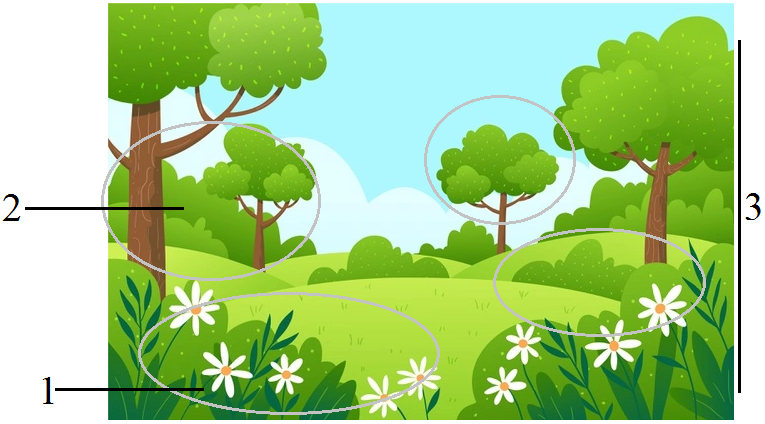
Ecosystem diversity is the variety of forms in the ecosystem due to diversity of niches, trophic levels and ecological processes like nutrient recycling, food webs, energy flow, etc. Study the given figure.

  1. Identify different types of diversity denoted by 1, 2 and 3 in the given figure.
 
1
2
3
(a)
Alpha diversity
Beta diversity
Gamma diversity
(b)
Gamma diversity
Alpha diversity
Beta diversity
(c)
Gamma diversity
Beta diversity
Alpha diversity
(d)
Beta diversity
Alpha diversity
Gamma diversity
  1. Alpha diversity is biodiversity present.
  1. Within conununity.
  2. Between conununities.
  3. In ranges of communities.
  4. None of these.
  1. Diversity represented by diversity of habitats over a total landscape area is:
  1. $\alpha-\text{diversity}$

  2. $\gamma-\text{diversity}$

  3. $\beta-\text{diversity}$

  4. $\delta-\text{diversity}$

  1. Concept of three types of ecological diversity was given by:
  1. Elton
  2. Odum
  3. Edward Wilson
  4. Whittaker
  1. The diversity of organisms sharing the same habitat or conununity is termed as:
  1. Alpha diversity.
  2. beta diversity.
  3. gamma diversity.
  4. delta diversity.
Describe different outbreeding devices in detail.###Describe different devices to discourage self pollination.###Describe different devices to encourage cross pollination.
Write a short note on pollination by wind.
Explain bioreactor with diagram.
Write a short note on endosperm development.
The size of a population for any species is not a static parameter. Explain.###Explain population growth###Explain in brief - population growth.
Read the following and answer any four questions from (i) to (v) given below:
Enzymes are best known for their ability to catalise biochemical reactions without undergoing any change. A large number of enzymes are being used in biotechnological industry. Most of them are obtained from microbes. Proteases degrade proteins and polypeptides. Most of the commercially applicable proteases are alkaline and are biosynthesised mainly by bacteria such as Pseudomonas, Bacillus and some fungi like, Aspergillus. These enzymes are used in clearing beer, softening of bread and meat, degumming of silk, etc. Alkaline serine proteases have the largest applications in bio-industry. Alkaline proteases have shown their capability to work under high pH, temperature and in presence of inhibitory compounds. Another important group of enzymes is amylases. Amylolytic enzymes act on starch. These are obtained from Aspergillus, Rhizopus and Bacillus sp. These are used in softening and sweetening of bread, production of alcoholic beverages from starchy materials, clearing of turbidity in juices caused by starch, etc.
  1. Polypeptides are degraded by:
  1. Amylases.
  2. Proteases.
  3. Pectinases.
  4. Lipases.
  1. Amylolytic enzymes are not obtained from:
  1. Aspergillus.
  2. Aspergillus.
  3. Mucor.
  4. Bacillus.
  1. Clearing of turbidity in juices caused by starch is achieved by:
  1. Amylases.
  2. Proteases.
  3. Rennet.
  4. Both (a) and (b).
  1. Select the incorrect option from the following.
  1. Enzymes are proteinaceous substances.
  2. Enzymes are substrate specific.
  3. Enzymes are large sized molecules.
  4. Microbial enzymes can work only in normal temperature and pH.
  1. A farmer harvests corns and prepares corn starch. He wants to prepare some corn syrup from this. for the conversion he needs to use enzyme ______.
  1. Amylase.
  2. Glucoamylases.
  3. Glucoisomerases.
  4. All of these.
Read the following and answer any four questions from (i) to (v) given below:

Regular change in temperature that occurs at specific intervals of time is called thennoperiodicity. It is of two types-diurnal and seasonal thermoperiodicity. Diumal periodicity refers to temperatures of day and night. It determines periods ofannual activity. In season periodicity different temperature prevails in different seasons of the year. 'Tiley favour different aspects of plant and animal life termed as phenology. For example in wheat, leaf growth requires a temperature of 10º-25ºC. Apple requires temperature below 7ºC for a period of 800 hrs before flowering and fruiting can occur. Low temperature is required for germination of some seeds as well as flowering in some plants. It also determines growth, reproduction, colour and morphology of animals. Both low and high temperature cause stress in organisms which is overcome by particular adaptations.

  1. Some plants require low temperature treatment for flowering. This phenomenon is known as:
  1. Photoperiodism.
  2. Vemalisation.
  3. Thermoperiodism.
  4. None of these.
  1. Animals found in arctic zones are called.
  1. microtherms
  2. Megatherms
  3. Mesotherms
  4. Hekistotherms
  1. Which of the following parts of wheat plant grows maximum in temperature around 10º-25ºC?
  1. Root
  2. Seeds
  3. Leaf
  4. Stem
  1. "Different temperatures prevail in different seasons of the year." It represents:
  1. Diurnal thermoperiodicity.
  2. Seasonal periodicity.
  3. Homeostasis.
  4. Thermoregulation.
  1. Assertion: Low and high temperature causes stress in organisms.

Reasons: Organisms show specific adaptations to overcome stressful condition.

  1. Both assertion and reason are true and reason is the correct explanation of assertion
  2. Both assertion and reason are true but reason is not the correct explanation of assertion.
  3. Assertion is true but reason is false.
  4. Both assertion and reason are false.