Question
Write a short note on pollination by wind.
Answer

Image
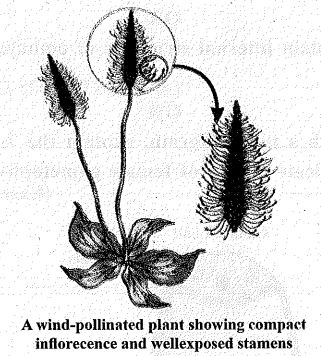
→ Pollination by wind is more common amongst abiotic pollinations.
→ Wind pollination also requires that the pollen grains are light and non-sticky so that they can be transported in wind currents.
→ They often possess well-exposed stamens so that the pollens are easily dispersed into wind currents, and large often-feathery stigma to easily trap air-borne pollen grains.
→ Wind pollinated flowers often have a single ovule in each ovary and numerous flowers packed into an inflorescence.
→ A familiar example is the corn cob the - tassels you see are nothing but the stigma and style which wave in the wind to trap pollen grains.
→ Wind-pollination is quite common in grasses.

Need a full question paper?

Generate a complete, print-ready paper with questions like this in minutes — across 16+ boards, with answer keys.
Start Generating Free

Similar questions

Read the following and answer any four questions from (i) to (v) given below:

Pollen-pistil interaction is the group of events that occur from the time of pollen deposition over the stigma to the time of pollen tube entry into ovule. It is a dynamic process which has checks at several places for promotion or inhibition of pollen growth. Pollen-pistil interaction is a safety measure to ensure that illegitimate crossings do not occur. Compatibility and incompatibility of the pollen-pistil is determined by special proteins. The compatible pollens are able to absorb water and nutrients from the surface of the stigma. They germinate and produce pollen tubes. Pollen tubes grow into the style. Their growth and path through the style are also determined by specific chemicals.

  1. Which of the following parts of gynoecium determines the compatible nature of pollen?
  1. Stigma.
  2. Style.
  3. Ovary.
  4. Thalamus.
  1. In Triforium, which type of self-incompatibility is found?
  1. Gametophytic self-incompatibility (GSI).
  2. Sporophytic self-incompatibility (SSI).
  3.  Both GSI and SSI.
  4. None of these.
  1. Select the incorrect statement.
  1. In Asteraceae, incompatibility is due to the genotype of the sporophytic stigmatic tissues.
  2. In members of Brassicaceae, incompatibility is due to the genotype of the pollen.
  3. Nature has imposed self-incompatibility to avoid highly homozygous individuals, which have a very low survival value.
  4. None of these.
  1. Which of the following are examples of self incompatibility?
  1. Tobacco.
  2. Potato.
  3. Crucifers.
  4. All of these.
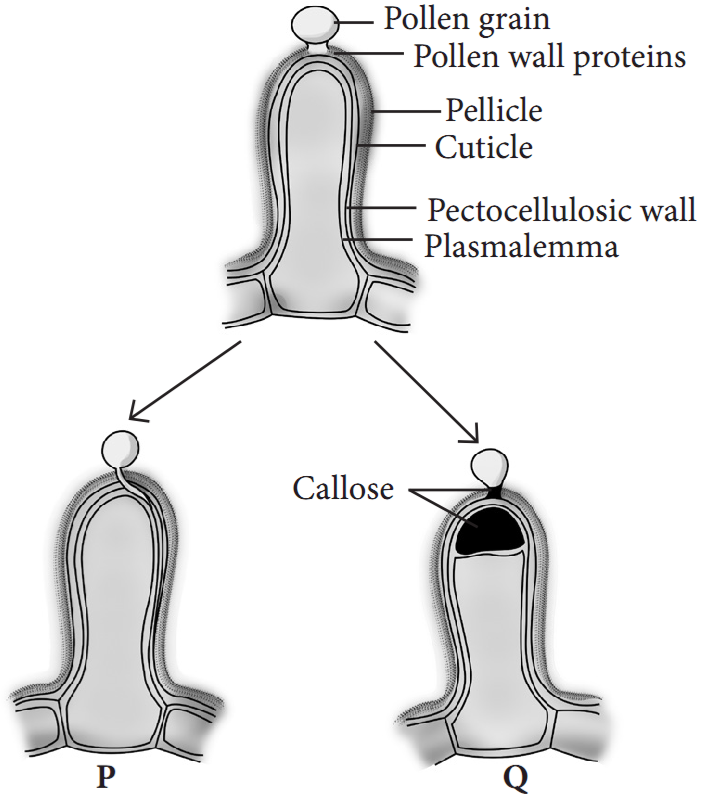
  1. Given figures show the pollen-stigma interaction, where pollen wall proteins are released onto the pellicle of stigmatic papillae, where a recognition reaction occurs.

Which of the following statements drawn from given figures is incorrect?
  1. P indicates compatible reaction in which the pollen tube penetrates the cuticle and grows down the papilla.
  2. Development of callose plug between the plasma membrane and pectocellulosic layer of stigmatic papillae results in the incompatibility reaction in Q.
  3. A callose plug, which appears at the tip of pollen in Q, is dissolved by callase enzyme secreted by stigma resulting in compatibility reaction.
  4. Deposition of callose can be employed as a reliable bioassay to detect compatibility or incompatibility reactions of pollen and stigma.
Write a note Lac operon
Read the following and answer any four questions from (i) to (v) given below:
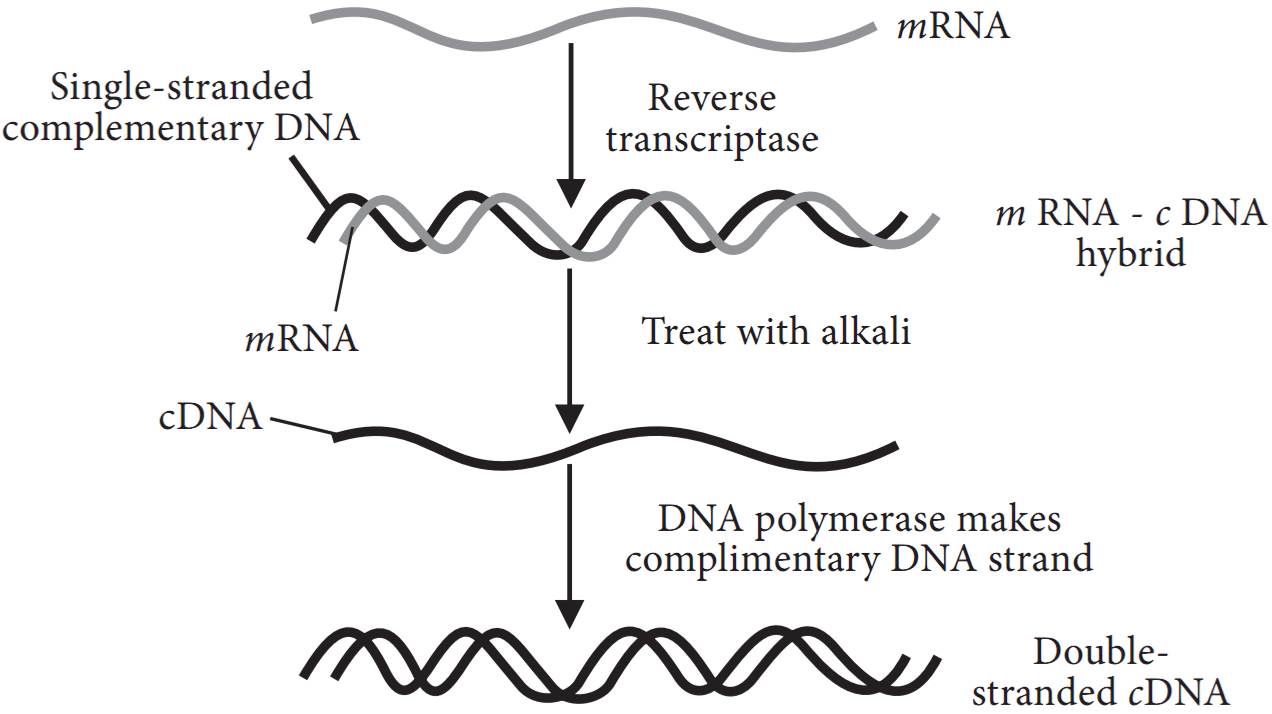
The DNA, which is transferred from one organism into another by joining it with the vehicle DNA is called passenger or foreign DNA. Generally three types of passenger DNAs are used. These are complementary DNA (cDNA), synthetic DNA (sDNA) and random DNA. Complementary DNA (cDNA) is synthesized on RNA template (usually mRNA) with the help of reverse transcriptase. Synthetic DNA (sDNA) is synthesized on DNA template or without a template. Random DNA are small fragments fanned by breaking a chromosome of an organism in the presence of restriction endonucleases.

  1. Reverse transcriptase enzyme was discovered by:
  1. Temin and Baltimore.
  2. Cohen and Boyer.
  3. Arber and Nathan.
  4. Paul Berg.
  1. During cDNA formation, what would happen if DNA formed by reverse transcriptase is not treated with the alkali?
  1. cDNA will not be digested.
  2. mRNA will not be digested.
  3. Hydrogen bonds will not form between base pairs.
  4. rnRNA will not be formed.
  1. Enzyme that helps in the formation of double stranded cDNA is:
  1. DNA synthetase
  2. Ligase
  3. DNA polymerase
  4. Helicase.
  1. DNA polymerase can be obtained form:
  1. Retrovirus.
  2. Agrobacteriurn.
  3. Tobacco mosaic virus.
  4. Thermus aquaticus.
  1. DNA synthesised without a template is referred to as:
  1. Complementary DNA.
  2. Random DNA.
  3. Synthetic DNA.
  4. Z-DNA..
Read the following and answer any four questions from (i) to (v) given below:

Reerna, Jai and Ankit are suffering from autoimmune diseases of adrenal cortex, joints and thyroid gland, respectively. Their immune system failed to recognise self and non-self and started destroying their body's own proteins. They are seeking proper medical help for their conditions but their condition cannot be cured completely.

Based on the above information, answer the following questions.

  1. Select the option that correctly identifies autoimmune diseases of Reema, Jai and Ankit.
S no.
Reema
Jai
Ankit
(a)
Diabetes
Grave's disease
Rheumatic fever
(b)
Pernicious anaemia
Multiple sclerosis
Myasthenia gravis
(c)
Addison's disease
Rheumatoid arthritis
Hashismoto's thyroiditis
(d)
Systemic lupus erythematosus
Severe combined immunodeficiency disease
AIDS
  1. Reema's autoimmune condition is characterised by
  1. Undersecretion of insulin.
  2. Destruction of RB Cs and low RB C count.
  3. Undersecretion of adrenal cortex hormones.
  4. Low production of intrinsic factor required for absorption of B12
  1. What do you think is the major cause of Jai's condition?
  1. Deterioration of myelin sheath around nerve cells, leading to loss of precise muscle control
  2. Destruction of heart cells, leading to weakening of entire heart wall.
  3. Destruction of beta cells, leading to undersecretion of insulin.
  4. Deposition of immune complexes of IgM, IgG and complement in joints thereby inflaming joints, destroying articular cartilage and fusing bones.
  1. How do you think Ankit's condition got diagnosed?
  1. Low level of thyroid hormone and elevated levels of TSH in Ankit's blood.
  2. Presence of antibodies against thyroid pen oxidase (TPO antibodies) in Ankit's blood.
  3. Elevated erythrocyte sedimentation rate (ESR), reduced C-reactive protein (CRP) in Ankit.
  4. Both (a) and (b)
  1. Assertion: Immunosuppressive drugs often reduce the severity of autoimmune disorders.

Reason: Monoclonal antibodies have been successfully used in the treatment of autoimmune disease.

  1. Both assertion and reason are true, and reason is the correct explanation of assertion.
  2. Both assertion and reason are true, but reason is not the correct explanation of assertion.
  3. Assertion is true, but reason is false.
  4. Both assertion and reason are false.
Read the following and answer any four questions from (i) to (v) given below:

Regular change in temperature that occurs at specific intervals of time is called thennoperiodicity. It is of two types-diurnal and seasonal thermoperiodicity. Diumal periodicity refers to temperatures of day and night. It determines periods ofannual activity. In season periodicity different temperature prevails in different seasons of the year. 'Tiley favour different aspects of plant and animal life termed as phenology. For example in wheat, leaf growth requires a temperature of 10º-25ºC. Apple requires temperature below 7ºC for a period of 800 hrs before flowering and fruiting can occur. Low temperature is required for germination of some seeds as well as flowering in some plants. It also determines growth, reproduction, colour and morphology of animals. Both low and high temperature cause stress in organisms which is overcome by particular adaptations.

  1. Some plants require low temperature treatment for flowering. This phenomenon is known as:
  1. Photoperiodism.
  2. Vemalisation.
  3. Thermoperiodism.
  4. None of these.
  1. Animals found in arctic zones are called.
  1. microtherms
  2. Megatherms
  3. Mesotherms
  4. Hekistotherms
  1. Which of the following parts of wheat plant grows maximum in temperature around 10º-25ºC?
  1. Root
  2. Seeds
  3. Leaf
  4. Stem
  1. "Different temperatures prevail in different seasons of the year." It represents:
  1. Diurnal thermoperiodicity.
  2. Seasonal periodicity.
  3. Homeostasis.
  4. Thermoregulation.
  1. Assertion: Low and high temperature causes stress in organisms.

Reasons: Organisms show specific adaptations to overcome stressful condition.

  1. Both assertion and reason are true and reason is the correct explanation of assertion
  2. Both assertion and reason are true but reason is not the correct explanation of assertion.
  3. Assertion is true but reason is false.
  4. Both assertion and reason are false.
Loss of habitat and fragmentation leads to loss in biodiversity. Explain with example.
Explain Competition as a population Interaction with suitable examples.
  1. What are the three options that can be thought of, to increase food production?
  2. Mention the reasons for the success of Green Revolution in increasing food production.
  3. Why do we still search for other alternatives to increase food production?
Read the following and answer any four questions from 2(i) to 2(v) given below:

Restriction endonuclease was isolated for the first ti me by W. Arb er in 1962 in bacteria. Restriction endonucleases cut the DNA duplex at specific points therefore they are also called as molecular scissors or biological scissors. Three types of restriction endonucleases are Type I, Type II and Type III but only Type II restriction endonucleases are used in recombinant DNA technology. Restriction endonuclease EcoR I recognises the base sequence GAATTC in DNA duplex and cut strands between G and A.

  1. Only type II restriction enzymes are used in gene manipulation because
  1. ATP is not required for cleaving.
  2. It consists of three different subunits.
  3. It makes cleavage or cut in both the strands of DNA molecule.
  4. Both (a) and (c).
  1. Which of the following ions are used by restriction endonucleases for restriction?
  1. Mg2+ ions
  2. Mn2+ ions
  3. Na2+ ions
  4. K2+ ions
  1.  Restriction endonuclease was isolated for the first time in a:
  1. Plant cell.
  2. Animal cell.
  3. Prokaryotic cell.
  4. Genninal cell.
  1. Restriction endonucleases are also called as molecular or biological scissors because,
  1. They cleave base pairs of DNA only at their terminal ends.
  2. They cleave one or both the strands of DNA.
  3. They act only on single stranded DNA.
  4. None of these.
  1. Select the option that correctly states the working action of restriction endonuclease EcoR I on DNA sequence GAATTC
  1. $\ \ \ \ \ \ \ \ \ \ \ \ \downarrow\\5'-\text{GAATTC}-3'\\3'-\text{CTTAAG}-5'\\\ \ \ \ \ \ \ \ \ \ \ \ \ \ \ \ \ \ \uparrow$

  2. $ \ \ \ \ \ \ \ \ \ \ \downarrow\\5'-\text{GAATTC}-3'\\3'-\text{CTTAAG}-5'\\\ \ \ \ \ \ \ \ \ \ \ \ \ \ \ \ \ \ \ \ \uparrow$

  3. $\ \ \ \ \ \ \ \ \ \ \ \ \ \ \ \ \ \ \ \ \ \downarrow\\5'-\text{GAATTC}-3'\\3'-\text{CTTAAG}-5'\\\ \ \ \ \ \ \ \ \ \uparrow$

  4. $\ \ \ \ \ \ \ \ \ \ \ \ \ \ \ \downarrow\\5'-\text{GAATTC}-3'\\3'-\text{CTTAAG}-5'\\\ \ \ \ \ \ \ \ \ \ \ \ \ \ \uparrow$

Give a brief account of evolution of vertebrates.