MCQ
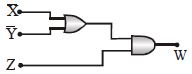
Output $W$ is given by
  • A
    $(X + Y)\, Z$
  • B
    $(X - Y)\, Z$
  • C
    $\bar X .\bar Y + Z$
  • $\left( {\bar X + \bar Y} \right)Z$

Answer

Correct option: D.
$\left( {\bar X + \bar Y} \right)Z$
d

Need a full question paper?

Generate a complete, print-ready paper with questions like this in minutes — across 16+ boards, with answer keys.

Start Generating Free

Similar questions

When a charged particle moves through a magnetic field, the quantity which is not affected in the magnetic field is:
The number of turns per unit length of a long solenoid is $10$ . If its average radius is $5 \,cm$ and it carries a current of $10 \,A$, then the ratio of flux densities obtained at the centre and at the end on the axis will be
When a resistance of $5\,\Omega$ is shunted with a moving coil galvanometer, it shows a full scale deflection for a current of $250\,mA$, however when $1050\,\Omega$ resistance is connected with it in series, it gives full scale deflection for $25$ volt. The resistance of galvanometer is $......\,\Omega$.
Let the refractive index of a denser medium with respect to a rarer medium be $n_{12}$ and its critical angle be $\theta_C$.  At an angle of incidence $A$ when light is travelling from denser medium to rarer medium, a part of the light is reflected and the rest is refracted and the angle between reflected and refracted rays is $90^o$.  Angle $A$ is given by
If only $2\,%$ of the main current is to be passed through a galvanometer of resistance $G$, then the resistance of shunt will be
Regarding a semiconductor which one of the following is wrong
Name the unit in which work function of a metal is generally expressed.
In series combination of resistances:
If a convex lens of focal length 80 cm and a concave lens of focal length 50 cm are combined together, what will be their resulting power
In a thermocouple, the temperature that does not depend on the temperature of the cold junction is called