Question
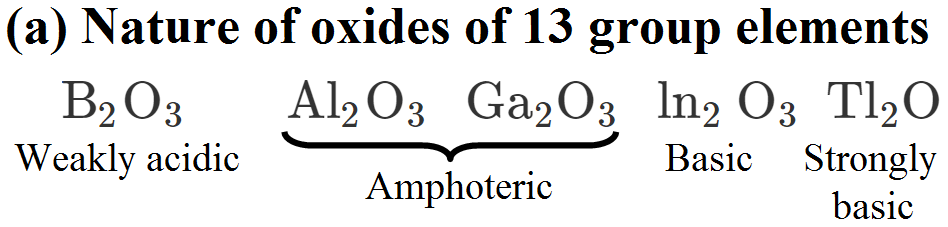
p-Block elements form acidic, basic and amphoteric oxides. Explain each property by giving two examples and also write the reactions of these oxides with water.
Answer

In p-block, when we move from left to right in a period, the acidic character of the oxides increases due to increase in electronegativity. For example,
In $2^{nd}$ period $B_2O_3 < CO_2 < N_2O_3$ (acidic nature increases).
In $3^{rd}$ period $A1_2O_3 < SiO_2 < P_4O_{10} < SO_3 < C1_2O_7$ (acidic character increases).
On moving down the group, acidic character decreases and basic character increases, e.g.,
  1. Nature of oxides of 15 group elements.
$\text{N}_2\text{O}_5\ \ \ \ \ \ \ \ \ \ \ \ \ \ \ \ \ \ \ \ \ \ \text{P}_4\text{O}_{10}\ \ \ \ \ \ \ \ \ \ \ \ \ \ \ \ \ \ \ \text{As}_4\text{O}_{10}\ \ \ \ \ \ \ \ \ \ \text{Sb}_4\text{O}_{10}\ \ \ \ \ \ \ \ \ \ \text{Bl}_2\text{O}_3\\ ^\text{Strongly acidic}\ \ \ \ \ \ \ \ \ ^\text{Moderately acidic}\ \ \ \ \ \ \ \ \ \ \ ^\text{Amphoteric}\ \ \ \ \ \ \ \ ^\text{Amphoteric}\ \ \ \ \ \ \ \ \ \ ^\text{Basic}$
Among the oxides of same element, higher the oxidation state of the element, stronger is the acid. For example, $SO_3$ is a stronger acid than $SO_2$.
$B_2O_3$ is weakly acidic and on dissolution in water, it forms orthoboric acid. Orthoboric acid does not act as a protonic acid (it does not ionise) but acts as a weak Lewis acid.
$\text{B}_2\text{O}_3\ \ \ \ \ \ \ \ \ \ +\ \ \ \ \ \ \ 3\text{H}_2\text{O}\ \ \ \rightleftharpoons\ \ \ \ 2\text{H}_3\text{BO}_3\\^\text{Boron trioxide}\ \ \ \ \ \ \ \ \ \ \ \ \ \ \ \ \ \ \ \ \ \ \ \ \ \ \ \ \ \ \ \ \ \ \ \ ^\text{Orthoboric acid}$
$\text{B(OH)}_3\ +\ \text{H}-\text{OH}\xrightarrow{\ \ \ \ \ \ \ \ \ \ \ \ }\big[\text{B}(\text{OH})_4\big]^{-}+\text{H}^+$
$Al_2O_3$ is amphoteric in nature. It is insoluble in water but dissolves in alkalies and reacts with acids.
$\text{Al}_2\text{O}_3\ \ +\ \ 2\text{NaOH}\ \xrightarrow{\ \ \ \ \ \ \ {\Delta} \ \ \ \ \ \ \ \ }\ 2\text{NaAlO}_2\ \ +\ \ \text{H}_2\text{O}\\ ^\text{Aluminium}\ \ \ \ \ \ \ \ \ \ \ \ \ \ \ \ \ \ \ \ \ \ \ \ \ \ \ \ \ \ \ \ \ \ \ \ \ \ ^\text{Sodium meta}\\ \ \ ^\text{trioxide}\ \ \ \ \ \ \ \ \ \ \ \ \ \ \ \ \ \ \ \ \ \ \ \ \ \ \ \ \ \ \ \ \ \ \ \ \ \ \ \ \ \ \ ^\text{chloride}$
$\text{Al}_2\text{O}_3\ \ +\ \ 6\text{HCl}\ \xrightarrow{\ \ \ \ \ \ \ {\Delta} \ \ \ \ \ \ \ \ }\ 2\text{AlCl}_3\ \ +\ \ 3\text{H}_2\text{O}\\ \ \ \ \ \ \ \ \ \ \ \ \ \ \ \ \ \ \ \ \ \ \ \ \ \ \ \ \ \ \ \ \ \ \ \ \ \ \ \ \ \ \ \ \ \ \ \ \ ^\text{Aluminium}\\ \ \ \ \ \ \ \ \ \ \ \ \ \ \ \ \ \ \ \ \ \ \ \ \ \ \ \ \ \ \ \ \ \ \ \ \ \ \ \ \ \ \ \ \ \ \ \ \ \ \ ^\text{chloride}$
$Tl_2O$ is as basic as NaOH due to its lower oxidation state (+1).
$\text{Tl}_2\text{O}\ +\ 2\text{HCl}\ \xrightarrow{\ \ \ \ \ \ \ \ \ \ \ \ }2\text{TlCl}\ +\ \text{H}_2\text{O}$

Need a full question paper?

Generate a complete, print-ready paper with questions like this in minutes — across 16+ boards, with answer keys.

Start Generating Free

Similar questions

Explain the non linear shape of $H_2S$ and non planar shape of $PCl_3$ using valence shell electron pair repulsion theory.
Describe the properties of covalent compounds.
  1. The reaction quotient of a reversible reaction is $Q_C$ and the equilibrium constant is $K_c$. What do you conclude for the reaction if $Q_c < K_c$?
  2. State Le Chatelier's principle.
  3. In qualitative analysis, $NH_4Cl$ is added before adding $NH_4OH$ solution for testing of III group radicals [$Fe^{3+}, Cr^{3+}$ and $Al^{3+}$]. Explain by using concept of common ion effect.
A neutral atom of an element has 2K, 8L and 5M electrons. Find out the following:
  1. Atomic number of the element.
  2. Total number of s-electrons.
  3. Total number of p-electrons.
  4. Number of protons in the nucleus.
  5. Valency of the element.
Which method can be used to find out strength of reductant/oxidant in a solution? Explain with an example.
What will be the pressure exerted by a mixture of $3.2g$ of methane and $4.4g$ of carbon dioxide contained in a $9dm^3$ flask at $27^\circ C$?
What is the effect of the following processes on the bond order in $N^-$, and $O_2$?
  1. $N_2 → N^+_2 + e^–$
  2. $O_2 → O^+_2 + e^–$
Green plants use carbon dioxide for photosynthesis and return oxygen to the atmosphere, even then carbon dioxide is considered to be responsible for green house effect. Explain why?
$\Delta\text{G}$ is net energy available to do useful work and is thus a measure of “free energy”. Show mathematically that $\Delta\text{G}$ is a measure of free energy. Find the unit of $\Delta\text{G}$ . If a reaction has positive enthalpy change and positive entropy change, under what condition will the reaction be spontaneous?
Arrange the following:
  1. During Clark's method, name the compound in which 'Mg' is precipated out?
  2. Give the formula of Zeolite used in ion exchange method to remove permanent hardness of water.
  3. Complete the following reaction:
$\text{BaO}_2.8\text{H}_2\text{O}(\text{s})+\text{H}_2\text{SO}_4(\text{aq})\xrightarrow{\ \ \ \ \ \ \ \ \ \ \ \ }$
  1. $H_2O_2$ is miscible with water. Assign reason.
  2. Name the compound which can be used as a hair bleach, mild antiseptic in form of perhydrol, as a rocket propellant in concentrated solution.