MCQ
p-n junction diode acts as:
- Aohmic resistance
- Bnon-ohmic resistance
- Cboth A and B
- Damplifier
Explanation:
We know that in the case of metallic conductors, the potential difference varies in direct proportion to the current flowing. The I−V graph of a ohmic conductor is a straight line. But, a p-n junction diode is not in according with Ohm's law. The current voltage characteristic curve of a p-n junction diode shows both forward bias as well as reverse bias characteristics as shown as in the graph.
Generate a complete, print-ready paper with questions like this in minutes — across 16+ boards, with answer keys.
Two pure inductors each of self inductance L are connected in parallel but are well separated from each other. The total inductance is
|
(a) 2L |
(b) L |
(c) |
(d) |
A voltmeter having a resistance of 998 ohms is connected to a cell of e.m.f. 2 volt and internal resistance 2 ohm. The error in the measurement of e.m.f. will be
|
(a) 4 |
(b) 2 |
(c) 4 |
(d) 2 |
A metallic square loop ABCD is moving in its own plane with velocity v in a uniform magnetic field perpendicular to its plane as shown in the figure. An electric field is induced
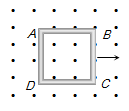
|
(a) In AD, but not in BC |
(b) In BC, but not in AD |
|
(c) Neither in AD nor in BC |
(d) In both AD and BC |
The energy liberated on complete fission of 1 kg of  is (Assume 200 MeV energy is liberated on fission of 1 nucleus)
|
(a) 8.2 |
(b) 8.2 |
(c) 8.2 |
(d) 8.2 |
Which of the following form(s) a virtual and erect image for all positions of the object
|
(a) Convex lens |
(b) Concave lens |
(c) Convex mirror |
(d) b, c |
In Bohr’s model, if the atomic radius of the first orbit is  , then the radius of the fourth orbit is
|
(a) |
(b) 4 |
(c) |
(d) 16 |


