MCQ
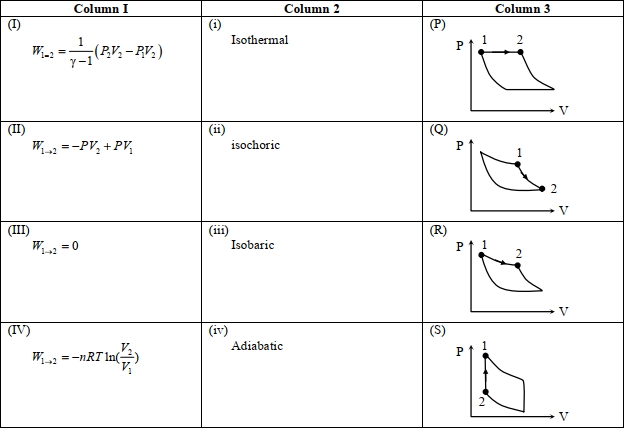
An ideal gas is undergoing a cyclic thermodynamic process in different ways as shown in the corresponding $P$ $V$ diagrams in column $3$ of the table. Consider only the path from state $1$ to $2 . W$ denotes the corresponding work done on the system. The equations and plots in the table have standard notations as used in thermodynamic processes. Here $\gamma$ is the ratio of heat capacities at constant pressure and constant volume. The number of moles in the gas is $n$.

(image)

($1$) Which of the following options is the only correct representation of a process in which $\Delta U=\Delta Q-P \Delta V$ ?

$[A] (II) (iv) (R)$    $[B] (II) (iii) (P)$    $[C] (II) (iii) (S)$   $[D] (III) (iii) (P)$

($2$)  Which one of the following options is the correct combination?

$[A] (III) (ii) (S)$    $[B] (II) (iv) (R)$   $[C] (II) (iv) (P)$   $[D] (IV) (ii) (S)$

($3$) Which one of the following options correctly represents a thermodynamic process that is used as a correction in the determination of the speed of sound in an ideal gas?

$[A] (III) (iv) (R)$  $[B] (I) (ii)$ $(\mathrm{Q})$   $[C] (IV) (ii) (R)$    $[D] (I) (iv) (Q)$
  • A
    $B,A,C$
  • $B,A,D$
  • C
    $B,A$
  • D
    $B,D$

Answer

Correct option: B.
$B,A,D$
b
($1$) The process must be isobaric.

($2$) The correct combination is for isochoric process.

($3$) The process must be adiabatic, which is used in Laplace correction over Newton's law for sound speed in air.

Need a full question paper?

Generate a complete, print-ready paper with questions like this in minutes — across 16+ boards, with answer keys.

Start Generating Free

Similar questions

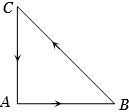
Three forces starts acting simultaneously on a particle moving with velocity $\vec v.$ These forces are represented in magnitude and direction by the three sides of a triangle $ABC$ (as shown). The particle will now move with velocity
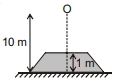
A body falling from a vertical height of $10 \,m$ pierces through a distance of $1 \,m$ in sand. It faces an average retardation in sand equal to ( $g$ = acceleration due to gravity)
For a refrigerator, heat absorbed from source is $800\, J$ and heat supplied to sink is $500\, J$ then the coefficient of performance is
Two projectiles $A$ and $B$ are thrown with the same speed but angles are $40^{\circ}$ and $50^{\circ}$ with the horizontal. Then
An object is allowed to fall from a height $R$ above the earth, where $R$ is the radius of earth. Its velocity when it strikes the earth's surface, ignoring air resistance, will be :
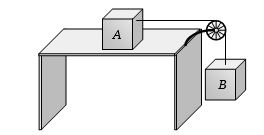
A block $A$ of mass $7 \,kg$ is placed on a frictionless table. A thread tied to it passes over a frictionless pulley and carries a body $B$ of mass $3\, kg$ at the other end. The acceleration of the system is .......... $ms^{-2}$          (given g = 10$m{s^{ - 2}})$
Roads are banked on curves so that
A cricket ball is hit at ${30^o}$ with the horizontal with kinetic energy $K$. The kinetic energy at the highest point is
Let $\omega$ be the angular velocity of the earth’s rotation about its axis. Assume that the acceleration due to gravity on the earth’s surface has the same value at the equator and the poles. An object weighed at the equator gives the same reading as a reading taken at a depth d below earth’s surface at a pole $(d < < R)$ The value of $d$ is
Entropy of a system decreases .........