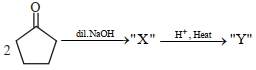
MCQ
$PC{l_5}$ exists but $NC{l_5}$ does not because
- ✓Nitrogen has no vacant orbitals
- B$NC{l_5}$ is unstable
- CNitrogen atom is much smaller
- DNitrogen is highly inert
Generate a complete, print-ready paper with questions like this in minutes — across 16+ boards, with answer keys.
$\begin{matrix}
\begin{matrix}
C{{H}_{3}}\,\,\,\,\,\,\,\, \,\, \\
|\,\,\,\,\,\,\,\,\,\,\,\,\,\,\,\,\,\, \\
\end{matrix} \\
C{{H}_{3}}-C-CH=C{{H}_{2}} \\
|\,\,\,\,\,\,\,\,\,\,\,\,\,\,\,\,\,\, \\
C{{H}_{3}}\,\,\,\,\,\,\,\, \,\,\,\, \\
\end{matrix}\,$ $\xrightarrow{{{H}_{2}}O/{{H}^{\oplus }}}$ $\underset{Major\,\,product}{\mathop{A}}\,$ $+$ $\underset{Major\,\,product}{\mathop{B}}\,$
The major product is
In the above reaction $A, B$ and $C $ are the following compounds
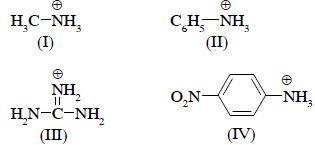
Consider the above reaction, the product $'X'$ and $'Y'$ respectively are :