MCQ
$PC{l_5}$ reacts with a compound containing
  • A
    $ - S{O_3}$ group
  • $-OH$ group
  • C
    $ - N{O_3}$ group
  • D
    $-NO$ group

Answer

Correct option: B.
$-OH$ group
b
(b) $PC{l_5}$ is used in organic chemistry to replace the $-OH$ group by $-Cl$ and carbonylic oxygen by $( - C{l_2})$.

Need a full question paper?

Generate a complete, print-ready paper with questions like this in minutes — across 16+ boards, with answer keys.

Start Generating Free

Similar questions

The enzymes act between the temperature range of:
Suppose the following reaction

$\begin{array}{*{20}{c}}
  {\,\,\,\,\,C{H_3}{\mkern 1mu} {\mkern 1mu} {\mkern 1mu} \,\,\,\,\,{\mkern 1mu} {\mkern 1mu} {\mkern 1mu} O{\mkern 1mu} } \\ 
  {\,\,\,|{\mkern 1mu} {\mkern 1mu} {\mkern 1mu} {\mkern 1mu} {\mkern 1mu} {\mkern 1mu} {\mkern 1mu} {\mkern 1mu} {\mkern 1mu} {\mkern 1mu} {\mkern 1mu} \,\,\,\,\,\,\,\,\,\,{\mkern 1mu} {\mkern 1mu} ||} \\ 
  {C{H_3} - CH - C - OH} 
\end{array}$ $+ C{H_3} - N{H_2} \to 'A'\xrightarrow[\Delta ]{}'B'\xrightarrow{\begin{subarray}{l} 
  {\text{LiAl}}{{\text{H}}_4} \\ 
  {\text{(excess)}} 
\end{subarray} }'C'$ 

The final product $‘C’$ will be

${\text{C}}{{\text{H}}_3} - CHO\xrightarrow{{dil.\,\,\mathop O\limits^\Theta  H/\Delta }}$

Major product formed in above reation is 

The effect of lanthanoid contraction in the lanthanoid series of elements by the large means
The $d-$electron configurations of $Cr^{2+}, Mn^{2+}, Fe^{2+}$ and $Co^{2+}$ are $d^4, d^5, d^6$ and $d^7$ respectively. Which one of the following will exhibit minimum paramagnetic behaviour ?

(At. nos. $Cr = 24, Mn = 25, Fe = 26, Co = 27$)
The reaction of $C_6H_5CH =CHCH_3$ with $HBr$ produces
The less reactivity of chlorine atom in $C{H_2} = CH - Cl$ is due to
Out of the following transition elements, the maximum number of oxidation states are shown by:
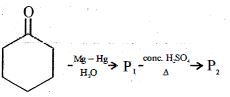
Select incoorect statement about $P_2$
The product formed when benzene is nitrated by fuming nitric acid is