MCQ
Penetrating power of $X-$ rays depends on
  • A
    Current flowing in the filament
  • Applied potential difference
  • C
    Nature of the target
  • D
    All the above

Answer

Correct option: B.
Applied potential difference
b
(b)The potential difference across the filament and target determines the energy and thence the penetrating power of $X-$ rays.

Need a full question paper?

Generate a complete, print-ready paper with questions like this in minutes — across 16+ boards, with answer keys.
Start Generating Free

Similar questions

The graph between the instantaneous concentration (N) of a radioactive element and time (t) is
A small pin fixed on a table top is viewed from above from a distance of $50\, cm$. By what distance would the pin appear to be raised if it is viewed from the same point through a $15\, cm$ thick glass slab held parallel to the table? Refractive index of glass $= 1.5$ ?......$cm$
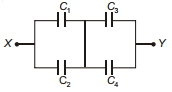
In the circuit shown below $C_1=10 \,\mu F , C_2=C_3=20 \,\mu F$, and $C_4=40 \,\mu F$. If the charge on $C_1$ is $20 \,\mu C$ then potential difference between $X$ and $Y$ is ......... $V$
Assertion : The number of electrons in a $p-$ type silicon semiconductor is less than the number of electrons in a pure silicon semiconductor at room temperature.
Reason : It is due to law of mass action
If the source of light used in a Young's Double Slit Experiment is changed from red to blue, then
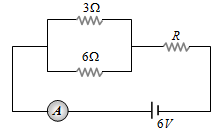
If the ammeter in the given circuit reads 2 A, the resistance R is
The muon has the same charge as an electron but a mass that is $207$ times greater. The negatively charged muon can bind to a proton to form a new type of hydrogen atom. How does the binding energy $E_{Bμ}$ of the muon in the ground state of a muonic hydrogen atom  compare with the binding energy $E_{Be}$ of an electron in the ground state of a conventional hydrogen atom ?
If a magnet is hanged with its magnetic axis then it stops in
A biconvex lens of refractive index $1.5$ has a focal length of $20 \mathrm{~cm}$ in air. Its focal length when immersed in a liquid of refractive index $1.6$ will be:
$\mu_\text{V}​>\mu_\text{R}$​ indicates: