MCQ
Phase difference between ac current and emf is $\frac{\pi}{2}$.Which of the following cannot be a component of the circuit?
- AL, C
- BOnly L
- COnly C
- ✓R, L
Generate a complete, print-ready paper with questions like this in minutes — across 16+ boards, with answer keys.
The distance between the extreme points on the periphery of the mirror is called:
$\frac{1}{4}\text{mgR}$
$\frac{1}{2}\text{mgR}$
$\text{mgR}$
$2\text{mgR}$
The kinetic energy of the electron in an orbit of radius r in hydrogen atom is (e = electronic charge)
|
(a) |
(b) |
(c) |
(d) |
A symmetric double convex lens is cut in two equal parts by a plane containing the principal axis. If the power of the original lens was 4D, the power of a divided lens will be:
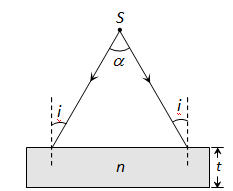
A diverging beam of light from a point source S having divergence angle a, falls symmetrically on a glass slab as shown. The angles of incidence of the two extreme rays are equal. If the thickness of the glass slab is t and the refractive index n, then the divergence angle of the emergent beam is
|
(a) Zero |
(b) α |
(c) |
(d) 2 |
Line spectrum was first of all theoretically explained by
|
(a) Swan |
(b) Fraunhofer |
(c) Kirchoff |
(d) Bohr |


