MCQ
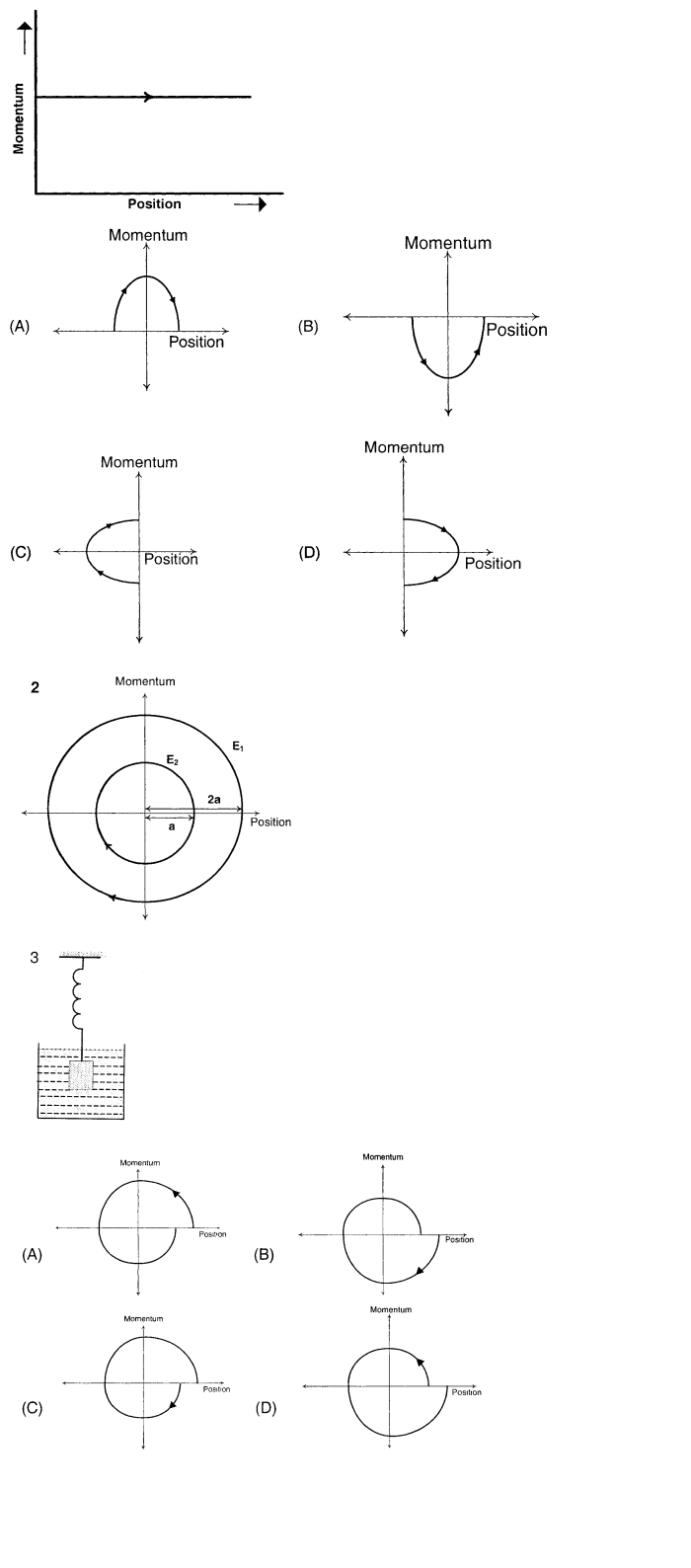
Phase space diagrams are useful tools in analyzing all kinds of dynamical problems. They are especially useful in studying the changes in motion as initial position and momentum are changed. Here we consider some simple dynamical systems in one-dimension. For such systems, phase space is a plane in which position is plotted along horizontal axis and momentum is plotted along vertical axis. The phase space diagram is $x(t)$ vs. $p(t)$ curve in this plane. The arrow on the curve indicates the time flow. For example, the phase space diagram for a particle moving with constant velocity is a straight line as shown in the figure. We use the sign convention in which position or momentum upwards (or to right) is positive and downwards (or to left) is negative. $Image$

$1.$ The phase space diagram for a ball thrown vertically up from ground is

mcq $Image$

$2.$ The phase space diagram for simple harmonic motion is a circle centered at the origin. In the figure, the two circles represent the same oscillator but for different initial conditions, and $E_1$ and $E_2$ are the total mechanical energies respectively. Then $Image$

$(A)$ $ E_1=\sqrt{2} E_2$ $(B)$ $ E_1=2 E_2$

$(C)$ $ E_1=4 E_2$ $(D)$ $ E_1=16 E_2$

$3.$ Consider the spring-mass system, with the mass submerged in water, as shown in the figure. The phase space diagram for one cycle of this system is $Image$

mcq $Image$

Give the answer question $1,2$ and $3.$
  • $(D,C,B)$
  • B
    $(A,B,C)$
  • C
    $(B,B,D)$
  • D
    $(D,A,D)$

Answer

Correct option: A.
$(D,C,B)$
a
$2.$ From diagram, Amplitude of oscillator $1=2 \times$ (Amplitude of oscillator $2$ )

$\Rightarrow E _1=4 E _2$

Need a full question paper?

Generate a complete, print-ready paper with questions like this in minutes — across 16+ boards, with answer keys.

Start Generating Free

Similar questions

This question has Statement $1$ and Statement $2.$ Of the four choices given after the Statements, choose the one that best describes the two Statements.
Statement $1:$ In an adiabatic process, change in internal energy of a gas is equal to work done on/by the gas in the process.

Statement $2 :$ The temperature of a gas remains constant in an adiabatic process.

Two bodies moving towards each other collide and move away in opposite directions. There is some rise in temperature of bodies because a part of the kinetic energy is converted into
Which of the following is not transported by electromagnetic waves?
A sinusoidal voltage $V(t) = 100\,sin\,(500t)$ is applied across a pure inductance of $L = 0.02\,H.$ The current through the coil is
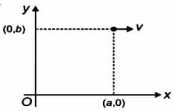
A particle is moving with constant speed $v$ in $x y$ plane as shown in figure. The magnitude of its angular velocity about point $O$ is .........
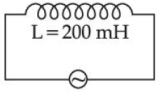
As shown in the figure an inductor of inductance $200\, mH$ is connected to an $AC$ source of emf $220 \,V$ and frequency $50 \,Hz$. The instantaneous voltage of the source is $0\, V$ when the peak value of current is $\frac{\sqrt{a}}{\pi} A$. The value of a is..........
A positive charge particle of $100 \,mg$ is thrown in opposite direction to a uniform electric field of strength $1 \times 10^{5} \,NC ^{-1}$. If the charge on the particle is $40 \,\mu C$ and the initial velocity is $200 \,ms ^{-1}$, how much distance (in $m$) it will travel before coming to the rest momentarily
A thin rod of length$f/3$ lies along the axis of a concave mirror of focal length $f.$ One end of its magnified image touches an end of the rod. The length of the image is
Force constant of a spring $(K)$ is synonymous to
Which of the following is not a dimensionless quantity?