MCQ
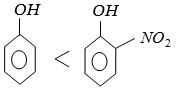
Phenol is less acidic than
  • A
    Ethanol
  • B
    Methanol
  • $o$-nitrophenol
  • D
    $p-$ methylphenol

Answer

Correct option: C.
$o$-nitrophenol
c
(c) Nitro group is electron with-drawing. Hence, increases acidic nature. 

Need a full question paper?

Generate a complete, print-ready paper with questions like this in minutes — across 16+ boards, with answer keys.

Start Generating Free

Similar questions

The ionization energy of nitrogen is larger than that of oxygen because of
$\begin{align}
  & C{{H}_{3}}-C\equiv CH\xrightarrow[dil.\,{{H}_{2}}S{{O}_{4}}]{HgS{{O}_{4}}}(A) \\ 
 & C{{H}_{3}}-C\equiv CH\xrightarrow[(2)\,{{H}_{2}}{{O}_{2}}/H{{O}^{-}}]{(1)\,B{{H}_{3}}.THF}(B) \\ 
\end{align}$

Product $(A)$ and $(B)$ is differentiated by

The disproportionation of $MnO _{4}^{2-}$ in acidic medium resulted in the formation of two manganese compounds $A$ and $B$. If the oxidation state of $Mn$ in $B$ is smaller than that of $A$, then the spin-only magnetic moment $(\mu)$ value of $B$ in $BM$ is $.........$ (Nearest integer)
The mass of zinc produced by the electrolysis of zinc sulphate solution with a steady current of $0.015\ A$ for $15$ minutes is ________________$\times 10^{-4} \mathrm{~g}$.$($ Atomic mass of zinc $=65.4 \ \mathrm{amu})$
Total number of essential amino acid among the given list of amino acids is . . . . 

Arginine, Phenylalanine, Aspartic acid, Cysteine, Histidine, Valine, Proline

$2.2\, g$ of nitrous oxide $\left( N _{2} O \right)$ gas is cooled at a constant pressure of $1\, atm$ from $310\, K$ to $270 \,K$ causing the compression of the gas from $217.1 \,mL$ to $167.75 \,mL$. The change in internal energy of the process, $\Delta U$ is ' $- x ^{\prime} J$. The value of ' $x$ ' is $....$

[nearest integer]

(Given: atomic mass of $N =14\, g \,mol ^{-1}$ and of $O$ $=16\, g\, mol ^{-1}$.

Molar heat capacity of $N _{2} O$ is $100\, JK ^{-1}\, mol ^{-1}$ )

Arrange the following in order of increasing dipole moment : $H_2O, H_2S, BF_3.$
Consider the following reactant sample

$(I)$ $1\,mol$ of $A$ and $2\,mol$ of $B$ in a $1\,L$ vessel

$(II)$  $2\,mol$ of $A$ and $2\,mol$ of $B$ in a $2\,L$ vessel

$(III)$ $0.2\,mol\, A$ and $0.2\,mol\,B$ in $0.1\,L$ vessel

Which reactant sample reacts by highest rate if reactant is in gaseous state and do not follow zero order reaction ?
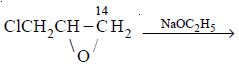
In the following reaction, final product is
If two compounds have the same empirical formula but different molecular formula, they must have