MCQ
Photo-electric effect can be explained by
  • A
    Corpusular theory of light
  • B
    Wave nature of light
  • C
    Bohr’s theory
  • Quantum theory of light

Answer

Correct option: D.
Quantum theory of light
d
(d) Quantum theory of light can explain the photoelectric effect that if a quanta of photon is incidented on the metal surface, the energy of photon breaks the electronnucleus interaction and thus an electron is emitted from the metal surface. Since some energy is required to break that interaction to emit the electron, so the photoelectric effect takes place from the metal surface only if the energy of photon is greater than the work function of that metal.

Need a full question paper?

Generate a complete, print-ready paper with questions like this in minutes — across 16+ boards, with answer keys.
Start Generating Free

Similar questions

Angle of minimum deviation for a prism of refractive index $1.5$ is equal to the angle of prism. The angle of prism is.......$^o$ ($cos 41^o  = 0.75$)
Avalanche breakdown in a $PN$ junction diode is due to
A copper ring is kept horizontal and a bar of magnet is dropped in the direction of the axis of the ring. The acceleration of the falling magnet will be:
Consider the following two statements:
  1. Line spectra contain information about atoms.
  2. Band spectra contain information about molecules.
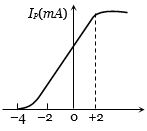
The mutual characteristic curves of a triode are as shown in figure. The cut off voltage for the triode is.....$V$
The capacities of two conductors are $C_1$ and $C_2$ and their respective potentials are $V_1$ and $V_2$. If they are connected by a thin wire, then the loss of energy will be given by 
Maximum magnification produced by simple micro-scope of focal length $f=5 \,cm$ is
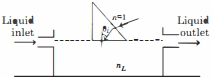
A right-angled isosceles prism is held on the surface of a liquid composed of miscible solvents $A$ and $B$ of refractive index $n_{A}=1.5$ and $n_{B}=1.3$, respectively. The refractive index of prism is $n_{p}=1.5$ and that of the liquid is given by $n_{L}=C_{A} n_{A}+\left(1-C_{A}\right) n_{B}$, where, $C_{A}$ is the percentage of solvent $A$ in the liquid. If $\theta_{C}$ is the critical angle at pris m-liquid interface, the plot which best represents the variation of the critical angle with the percentage of solvent is
An electron is released from rest in a region of space with a non-zero electric field. Which of the following statements is true?
A thin mica sheet of thickness $2 \times 10^{-6} m$ and refractive index μ = 1.5 is introduced in the path of the first wave. The wavelength of the wave used is 5000 Å. The central bright maximum will shift