MCQ
Photoelectric effect was explained by :
- ANewton
- ✓Einstein
- CPlanck
- DBohr
Generate a complete, print-ready paper with questions like this in minutes — across 16+ boards, with answer keys.
The points resembling equal potentials are
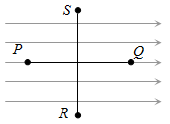
|
(a) P and Q |
(b) S and Q |
(c) S and R |
(d) P and R |
An electron initially at rest, is accelerated through a potential difference of 200 volt, so that it acquires a velocity 8.4  . The value of e/m of electron will be
|
(a) 2.76 |
(b) 1.76 |
(c) 0.76 |
(d) None of these |
+ 2C and +6C two charges are repelling each other with a force of 12N. If each charge is given -2C of charge, then the value of the force will be
|
(a) 4N (Attractive) |
(b) 4N (Repulsive) |
(c) 8N (Repulsive) |
(d) Zero |
At a point 20 cm from the centre of a uniformly charged dielectric sphere of radius 10 cm, the electric field is 100 V/m. The electric field at 3 cm from the centre of the sphere will be
|
(a) 150 V/m |
(b) 125 V/m |
(c) 120 V/m |
(d) Zero |
Consider the following statements A to B and identify the correct answer
A. Polarised light can be used to study the helical surface of nucleic acids.
B. Optics axis is a direction and not any particular line in the crystal
|
(a) A and B are correct |
(b) A and B are wrong |
|
(c) A is correct but B is wrong |
(d) A is wrong but B is correct |
Assertion : Magnetic moment of an atom is due to both, the orbital motion and spin motion of every electron.
Reason : A charged particle produces a magnetic field.
|
(a) If both assertion and reason are true and the reason is the correct explanation of the assertion. |
|
(b) If both assertion and reason are true but reason is not the correct explanation of the assertion. |
|
(c) If assertion is true but reason is false. |
|
(d) If the assertion and reason both are false. |

