MCQ
Pick out the temperature at which iron becomes paramagnetic?
  • $800^\circ C$
  • B
    $700^\circ C$
  • C
    $600^\circ C$
  • D
    $500^\circ C$

Answer

Correct option: A.
$800^\circ C$
Iron is a ferromagnetic material. Ferromagnetism decreases with a rise in temperature, and above a certain temperature called “Curie’s temperature,” ferromagnets become paramagnets. For iron, it is approximately, $800^\circ C.$

Need a full question paper?

Generate a complete, print-ready paper with questions like this in minutes — across 16+ boards, with answer keys.
Start Generating Free

Similar questions

A small object is placed at a distance of $4 \,m$ from the objective of a telescope of focal length $2 \,m$. The focal length of the eyepiece is $0.2 m$. The final image of the object
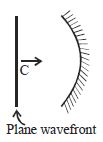
When a plane wave front incident on a concave mirror as shown in figure then shape of reflected wave front
Which of the following is not the property of a cathode ray
Consider the following statements regarding the photoelectric eff ect experiment:

$(I)$ Photoelectrons are emitted as soon as the metal is exposed to light.

$(II)$ There is a minimum frequency below which no photo-current is observed.

$(III)$ The stopping potential is proportional to the frequency of light.

$(IV)$ The photo-current varies linearly with the intensity of the light.

Which of the above statements indicate that light consists of quanta (photons) with energy proportional to frequency?
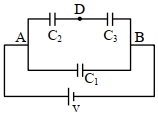
Three capacitors ${C}_{1}=2\, \mu {F}, {C}_{2}=6 \, \mu {F}$ and ${C}_{3}=12 \, \mu {F}$ are connected as shown in figure. Find the ratio of the charges on capacitors ${C}_{1}, {C}_{2}$ and ${C}_{3}$ respectively:
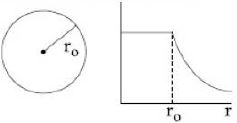
The give graph shown variation (with distance $r$ from centre) of
A proton and a deuteron are both accelerated through the same potential difference and enter in a magnetic field perpendicular to the direction of the field. If the deuteron follows a path of radius $R ,$ assuming the neutron and proton masses are nearly equal, the radius of the proton' s path will be
According to Lenz's law there is conversion of:
An electric dipole is placed in an electric field generated by a point charge
If heat is supplied to an ideal gas in an isothermal process: