Question
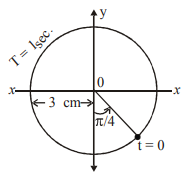
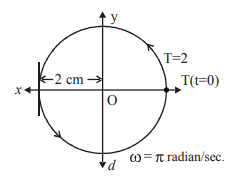
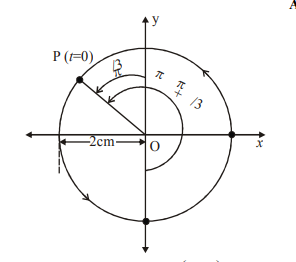
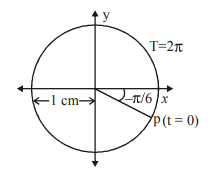
Plot the corresponding reference circle for each of the following simple harmonic motions. Indicate the initial $(t=0)$ position of the particle, the readius of the circle, and the angular speed of the rotating particle. For simplicity, the sense of rotation may be fixed to be anticlockwise in every case ( $x$ is in cm and $t$ is in s).
(a) $x=-2 \sin (3 t+\pi / 3)$
(b) $x=\cos (\pi / 6-t)$
(c) $x=3 \sin (2 \pi t+\pi / 4)$
(d) $x=2 \cos \pi t$
Need a full question paper?

Generate a complete, print-ready paper with questions like this in minutes — across 16+ boards, with answer keys.

Start Generating Free

Similar questions

If 28 × 1023 molecules of a gas strike a surface of area 14cm2 normally per second with velocity of 500 ms-1 and rebound in the opposite direction with the same speed find the pressure exerted by the gas on the surface if mass of each molecule is 5 × 10-23 g.
For the harmonic travelling wave $\text{y}=2\cos2\pi(10\text{t}-0.0080\text{x}+3.5)$ where x and y are in cm and t is second. What is the phase difference between the oscillatory motion at two points separated by a distance of:
What is the phase difference between the oscillation of a particle located at x = 100cm at t = T and t = 5s?
What are progressive wave? Establish the equation representing progressive wave and explain phase and path difference.
OR
Establish the equation of plane progressive wave and find out phase difference.
Find $\gamma$ for polyatomic gas and hence determine its value for a triatomic gas in which the molecules are linearly arranged.
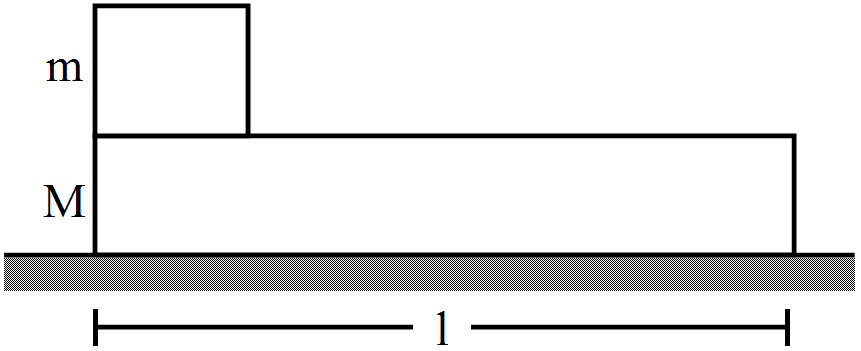
Figure shows a small block of mass m kept at the left end of a larger block of mass M and length l. The system can slide on a horizontal road. The system is started towards right with an initial velocity v. The friction coefficient between the road and the bigger block is g and that between the block is $\frac{\mu}{2}.$ Find the time elapsed before the smaller blocks separates from the bigger block.

State the law of equipartition of energy of a dynamic system and use it to find the values of internal energy and the ratio of the specific heats of (a) monoatomic, (b) diatomic, (c) triatomic gas molecules.
A conducting loop of area 5.0cm2 is placed in a magnetic field which varies sinusoidally with time as $\text{B}=\text{B}_0\sin\omega\text{t}$ wherer $\text{B}_0=0.20\text{T}$ and $\omega=300\text{s}^{-1}.$ The normal to the coil makes an angle of 60° with the field. Find
  1. The maximum emf induced in the coil.
  2. The emf induced at $\text{t}=\Big(\frac{\pi}{900}\Big)\text{s}$
  3. $\text{t}=\Big(\frac{\pi}{600}\Big)\text{s}.$
  4. The emf induced at $\text{t}=\Big(\frac{\pi}{600}\Big)\text{s}.$
A block of mass m moving with speed v compresses a spring through a distance x before its speed is halved. What is the value of spring constant?
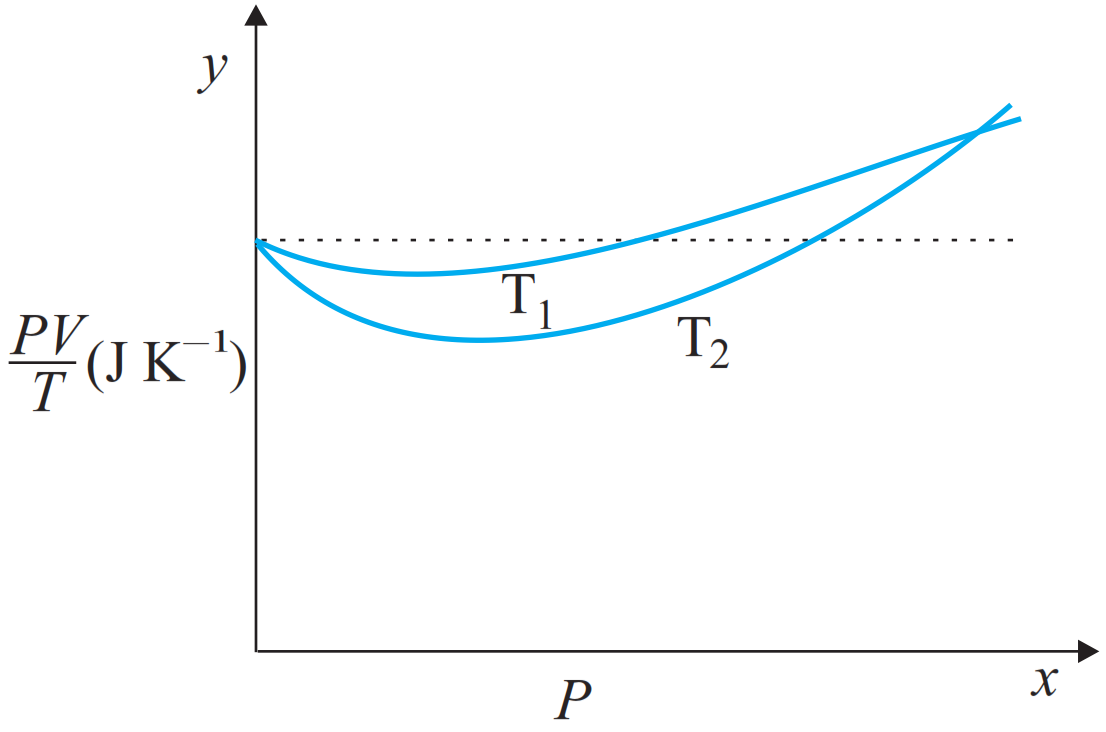
Shows plot of $\frac{\text{PV}}{\text{T}}$ versus P for 1.00 × 10⁻³kg of oxygen gas at two different temperatures:

What is the value of $\frac{\text{PV}}{\text{T}}$ where the curves meet on the y-axis?

A threaded rod with 12turns/ cm and diameter 1.18cm is mounted horizontally. A bar with a threaded hole to match the rod is screwed onto the rod. The bar spins at 216rev/ min. How long will it take for the bar to move 1.50cm along the rod?