MCQ
Ploughing help to retain water by soil ...........
  • A
    By creating capillaries
  • By breaking capillaries
  • C
    By turning the soil upside down
  • D
    None of these

Answer

Correct option: B.
By breaking capillaries
b
(b)

By breaking capillaries as they do not allow water to seep inside.

Need a full question paper?

Generate a complete, print-ready paper with questions like this in minutes — across 16+ boards, with answer keys.
Start Generating Free

Similar questions

Two drops of the same radius are falling through air with a steady velocity of $5 cm per sec.$  If the two drops coalesce, the terminal velocity would be
Suppose a vertical tunnel is dug along the diameter of earth assumed to be a sphere of uniform mass having density $\rho$. If a body of mass $m$ is thrown in this tunnel, its acceleration at a distance $y$ from the centre is given by
Two balls of same mass are projected with the same speed one vertically upwards and the other at angle $60^o$ with the vertical. The ratio of their potential energies at the  highest point is :-
The latent heat of vaporization of a substance is always
Two gases of equal mass are in thermal equilibrium. If ${P_a},\,{P_b}$ and ${V_a}$ and ${V_b}$ are their respective pressures and volumes, then which relation is true
A beaker contains a fluid of density $\rho \, kg / m^3$, specific heat $S\, J / kg\,^oC$ and viscosity $\eta $. The beaker is filled upto height $h$. To estimate the rate of heat transfer per unit area $(Q / A)$ by convection when beaker is put on a hot plate, a student proposes that it should depend on $\eta \,,\,\left( {\frac{{S\Delta \theta }}{h}} \right)$ and $\left( {\frac{1}{{\rho g}}} \right)$ when $\Delta \theta $ (in $^oC$) is the difference in the temperature between the bottom and top of the fluid. In that situation the correct option for $(Q / A)$ is
A uniform thin wooden plank $A B$ of length $L$ and mass $M$ is kept on a table with its $B$ end slightly outside the edge of the table. When an impulse $J$ is given to the end $B$, the plank moves up with centre of mass rising a distance $h$ from the surface of the table. Then,
A solid cylinder of mass $3\, kg$ is rolling on a horizontal surface with velocity $4\, m s^{- 1}$. It collides with a horizontal spring of force constant $200 \,N m^{-1}$. The maximum compression produced in the spring will be ............... $\mathrm{m}$
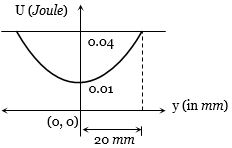
The variation of potential energy of harmonic oscillator is as shown in figure. The spring constant is
Initially spring in its natural length now a block at mass $0.25 \,kg$ is released than find out maximum force by system on floor ? (in $N$)