MCQ
Power delivered by the source of the circuit becomes maximum, when
  • A
    $\omega L = \omega C$
  • $\omega L = \frac{1}{{\omega C}}$
  • C
    $\omega L = - \,{\left( {\frac{1}{{\omega C}}} \right)^2}$
  • D
    $\omega L = \sqrt {\omega C} $

Answer

Correct option: B.
$\omega L = \frac{1}{{\omega C}}$
b
b
As we know,

power delivered by the source of the circuit becomes maximum when, load resistance equals to source resistance.

we know, in $L-C-R$ circuit,

load resistance is inductive reactance and source resistance is reactance of capacitor.

$\text { e.g., } X_L=X_C$

or, $\omega L =\frac{1}{\omega C }$

hence, Power delivered by the source of the circuit becomes maximum, when,

$\omega L =\frac{1}{\omega C }$

Need a full question paper?

Generate a complete, print-ready paper with questions like this in minutes — across 16+ boards, with answer keys.

Start Generating Free

Similar questions

An $LED$ is constructed from a $p-n$ junction diode using $GaAsP$. The energy gap is $1.9\; eV$. The wavelength of the light emitted will be equal to
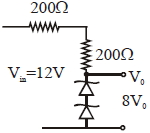
The circuit shown below is working as a $8\; \mathrm{V}\;dc$ regulated voltage source. When $12 \;\mathrm{V}$ is used as input, the power dissipated (in $\mathrm{mW}$ ) in each diode is

(considering both zener diodes are identical)
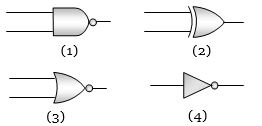
Given below are symbols for some logic gates The $XOR$ gate and $NOR$ gate respectively are
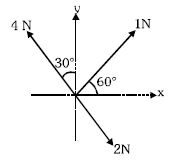
Three forces acting on a body are shown in the figure. To have the resultant force only along the $y-$ direction, the magnitude of the minimum additional force needed is.........$N$ 
The volume of an air bubble is doubled as it rises from the bottom of lake to its surface. The atmospheric pressure is $75 \,cm$ of mercury. The ratio of density of mercury to that of lake water is $\frac{40}{3}$. The depth of the lake in metre is .........
From the top of a tower of height $40\, m,$ a ball is projected upwards with a speed of $20\, m/s$ at an angle $30^o$ to the horizontal. The ball will hit the ground in time ........$s$ (Take $g = 10\, m/s^2$)
A gaseous mixture contains equal number of hydrogen and nitrogen molecules. Specific heat measurements on this mixture at temperatures below $100\, K$ would indicate that the value of $\gamma $ (ratio of specific heats) for this mixture is
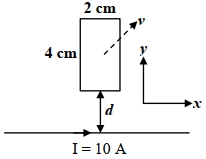
A rectangular conducting loop of length $4 \mathrm{~cm}$ and width $2 \mathrm{~cm}$ is in the $x y$-plane, as shown in the figure. It is being moved away from a thin and long conducting wire along the direction $\frac{\sqrt{3}}{2} \hat{x}+\frac{1}{2} \hat{y}$ with a constant speed $v$. The wire is carrying a steady current $\mathrm{I}=10 \mathrm{~A}$ in the positive $x$-direction. A current of $10 \mu \mathrm{A}$ flows through the loop when it is at a distance $d=4 \mathrm{~cm}$ from the wire. If the resistance of the loop is $0.1 \Omega$, then the value of $v$ is. . . . . . .$\mathrm{ms}^{-1}$.

[Given: The permeability of free space $\mu_0=4 \pi \times 10^{-7} \mathrm{NA}^{-2}$ ]
A star emits light of $5500 Å$ wavelength. Its appears blue to an observer on the earth, it means
A convex lens is used to form real image of an object on a screen. It is observed that even when the positions of the object and that screen are fixed there are two positions of the lens to form real images. If the heights of the images are $4 cm$ and $9 cm$ respectively, the height of the object is.....$cm$