Question
prism can produce a minimum deviation $\delta$ in a light beam. If three such prisms are combined, the minimum deviation that can be produced in this beam is:

  1. $0$

  2. $\delta$

  3. $2\delta$

  4. $3\delta$

Answer

  1. $\delta$

Explanation:

In combination (refractive angles of prisms reversed with respect to each other), the deviations through two prisms cancel out each other and the net deviation is due to the third prism only.

Need a full question paper?

Generate a complete, print-ready paper with questions like this in minutes — across 16+ boards, with answer keys.

Start Generating Free

Similar questions

By opening the door of a refrigerator placed inside a room you
If speed $(V)$, acceleration $(A)$ and force $(F)$ are considered as fundamental units, the dimension of Young’s modulus will be
A body weighs $250\,N$ on the surface of the earth. ....... $N$ will it weigh half way down to the centre of the earth .
A student determined Young's Modulus of elasticity using the formula $Y=\frac{M g L^{3}}{4 b d^{3} \delta} .$ The value of $g$ is taken to be $9.8 \,{m} / {s}^{2}$, without any significant error, his observation are as following.

Physical Quantity Least count of the Equipment used for measurement Observed value
Mass $({M})$ $1\; {g}$ $2\; {kg}$
Length of bar $(L)$ $1\; {mm}$ $1 \;{m}$
Breadth of bar $(b)$ $0.1\; {mm}$ $4\; {cm}$
Thickness of bar $(d)$ $0.01\; {mm}$ $0.4 \;{cm}$
Depression $(\delta)$ $0.01\; {mm}$ $5 \;{mm}$

Then the fractional error in the measurement of ${Y}$ is

A sphere contracts in volume by $0.01 \%$ when taken to the bottom of sea $1 \,km$ deep. Find Bulk modulus of the material of sphere ........... $N / m ^2$
For cooking the food, which of the following type of utensil is most suitable
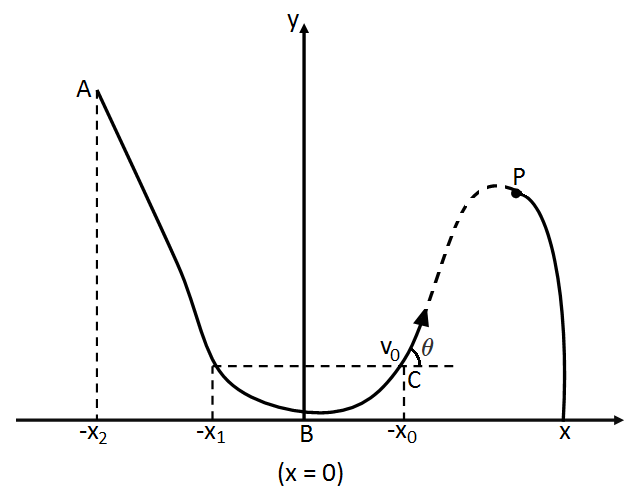
A particle slides down a frictionless parabolic (y = x) track (A – B – C) starting from rest at point A. Point B is at the vertex of parabola and point C is at a height less than that of point A. After C, the particle moves freely in air as a projectile. If the particle reaches highest point at P, then

  1. KE at P = KE at B.
  2. height at P = height at A.
  3. total energy at P = total energy at A.
  4. time of travel from A to B = time of travel from B to P.
The moment of inertia of a disc of radius $0.5\,\,m$  about its geometric axis is $2\,kg-m^2.$ If a string is tied to its circumference and a force of $10$  $newton$ is applied, the value of torque with respect to this axis will be ........ $N-m.$
A stone of mass $m$, tied to a string is being whirled in a vertical circle with a uniform speed. The tension in the string is
The dimensions of Planck's constant and angular momentum are respectively