MCQ
product $(B)$ is
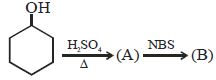
  • A


  • C

  • D
    None

Answer

Correct option: B.

b

Need a full question paper?

Generate a complete, print-ready paper with questions like this in minutes — across 16+ boards, with answer keys.

Start Generating Free

Similar questions

$\begin{matrix}
   \,\,\,\,\,O\,\,\,\,\,\,\,\,\,\,\,\,\,\,\,\,\,\,\,\,\,\,\,\,C{{H}_{3}}  \\
   ||\,\,\,\,\,\,\,\,\,\,\,\,\,\,\,\,\,\,\,\,\,\,\,\,\,\,\,\,|\,  \\
   C{{H}_{3}}-C-C{{H}_{2}}-C-CHO  \\
   \,\,\,\,\,\,\,\,\,\,\,\,\,\,\,\,\,\,\,\,\,\,\,\,\,\,\,\,\,\,\,|  \\
   \,\,\,\,\,\,\,\,\,\,\,\,\,\,\,\,\,\,\,\,\,\,\,\,\,\,\,\,\,\,\,\,\,\,\,\,C{{H}_{3}}  \\
\end{matrix}\xrightarrow{KOH,{{H}_{2}}O}(A);$ Product $A$ is
Which has the maximum ferromagnetic character
An element having the electronic configuration $\left[ {Ar} \right]3{d^2}4{s^2}$ belongs to
Which compound is volatile on heating?
Which of these reagents would accomplish the following reduction ?

$\begin{matrix}
   O\,\,\,\,\,\,\,\,\,\,\,\,\,\,\,\, \,\, \\
   ||\,\,\,\,\,\,\,\,\,\,\,\,\,\,\,\,\,\,  \\
   N\equiv C-C{{H}_{2}}-C-C{{H}_{2}}-CH=C{{H}_{2}}\to   \\
\end{matrix}$ $\begin{matrix}
   OH\,\,\,\,\,\,\,\,\,  \\
   |\,\,\,\,\,\,\,\,\, \,\,\,\, \\
   N\equiv C-C{{H}_{2}}-\underset{H}{\mathop{C}}\,-C{{H}_{2}}-CH=C{{H}_{2}}  \\
\end{matrix}$

Which of the following process can not give $Cl_2$ gas
If C4​H9​Cl with Na/ether gives 2,5-dimethylhexane, then the compound, C4​H9​Cl is:
$\begin{array}{*{20}{c}}
  O \\ 
  {||} \\ 
  {C{H_3} - C - C{H_3}} 
\end{array}$ $\xrightarrow{{{I}_{2}}/NaOH}\underset{\begin{smallmatrix} 
 yellow\,\,compound \\ 
 \,\,\,\,\,\,\,\,\,\,\,\,\,\,\,\,\,\,\,\,\,+ 
 \\ 
 \,\,\,\,\,\,\,\,\,\,\,\,\,\,\,\,\,\,\,\,(B) 
\end{smallmatrix}}{\mathop{(A)}}\,$ $\xrightarrow[\Delta ]{{Ag - powder}}(C)$ $\xrightarrow{{Dil\,\,{H_2}S{O_4}/HgS{O_4}}}(D)$

$A, C$ and $D$ are :-

The number of unpaired electrons is maximum in (Atomic no. : $ Ti = 22; V= 23; Cr = 24; Fe = 26$)
$2\,moles$ of liquid $A$ is mixed with $3\,moles$ of liquid $B.$ The mole fraction of $A$ in vapour phase if $P_A^o\, = \,100\,\,mm$ and $P_B^o\, = \,200\,\,mm$